Inside Dennis Reed II’s Mission to Make Detroit a Film Powerhouse
Detroit isn’t waiting for Hollywood’s approval. Filmmaker Dennis Reed II is helping redefine independent cinema, producing dozens of films and showcasing why the Motor City remains a blueprint for creativity and storytelling.
Filmmaker Dennis Reed II is walking through his 45,000 sq ft Southfield studio pointing out the various sets. There’s a room with a hospital bed and IV for medical scenes, a full courtroom with a judge’s bench and a jury section. There’s a bedroom, kitchen, church sanctuary, and jail cell with a 13 inch TV and a toilet. “You’re looking at 2 years of hard work bro in putting all this together,” said Reed.
Reed is Detroit’s Tyler Perry. Through DR2 Productions, Reed has written and directed over 50 films and a dozen series (mostly through the Tubi streaming platform). In one year alone, he filmed 16 movies.
“I would never do that again,” said Reed. “I feel like when I burn myself out I’m not giving ya’ll the best.”
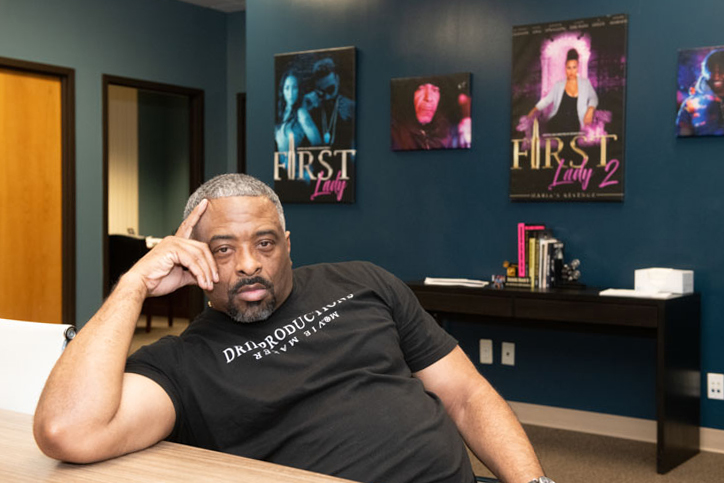
Before Reed was a Tubi tycoon, he was a young adult trying to find his way through different entrepreneurial and artistic endeavors. Reed was originally born in New York, moved to Detroit when he was 10 years-old, graduated from Henry Ford high school in 1994, and says he never worked for anyone but his parents. In April of 2005, he was victim of gun violence, an incident he refers to as, “life changing.” As his body recovered, he used writing as a way to heal both emotionally and spiritually.
“Writing saved my life,” said Reed. “It made me see past the bullcrap, and it came at a time when I needed it.”
But it wasn’t just about healing. Reed also found passion and purpose every time he took pen to pad, as creating characters and crafting storylines quickly became addictive.
“Writing is still my favorite part, that’s when I’m everybody,” said Reed. “That’s when I can be whoever I want to be. If I want to be a teacher. If I want to be a doctor. If I want to be a lawyer. If I want to be a drug dealer, whatever.”
In 2005, Reed self-published his first book, “He Said, She Said,” a fictional tale of a couple navigating relationship drama. Thereafter, three more books followed, and Reed began peddling his books on street corners and hair salons in Detroit, New York, and Chicago.
“I had a whole little schedule. I would hit Chicago for a weekend.I leave out early in the morning on a Saturday and I’m selling until about 6 o’clock,” said Reed.
By 2007 Reed had turned “He Said, She Said” into a play, and featured it at both Detroit’s Masonic Temple and Charles H. Wright Museum of African American History. More plays followed and four years later, he took his biggest leap of faith and produced his first film, “True Law,” a gritty tale about a law firm plagued by murder, drugs, and a love triangle (which was also his second book). The movie created a strong buzz and Reed followed it with, “He Said, She Said.”
Reed kept pen to the pad and improved the production quality with every movie released. He switched from releasing films on Amazon Prime to the Tubi streaming app because their revenue was higher. He also started 1919 Distribution, a digital distribution company that allowed him to cut out the middle man in getting his projects to streaming apps. In 2018, he caught lightning in a bottle when he released “First Lady,” a film about a widow mourning the murder of her husband while falling in love with his killer. The film starred rapper Jim Jones and reality TV stars Nicole “Hoops” Alexander, and Royce Reed.
“That was the first time I was incorporating people that weren’t from Detroit in my film,” said Reed.
The film earned him his first million dollars and simultaneously helped pole vault Reed and Detroit into the center of Tubi’s independent film universe. Reed, alongside filmmakers Renika McQueen-Echo, Melissa Talbot, Ken Williams, Darren Brown, Al Nuke, Randy Holloway, Paige Alston, Mula Flims, are just a few of the local creatives behind Detroit’s surge in independent filmmaking.
“I think we have one of the largest collections of films made by Detroit filmmakers. I think we have over a thousand titles that are made by storytellers and creatives in Detroit,” said Anjali Sud, Detroit native and CEO of Tubi in a February 2025 interview.
From music and fashion, to film and art – Detroit’s influence can be seen all around the world. Detroit’s film culture is about taking ownership of that influence but also taking control of their own narratives, rather than allowing Hollywood to define or dictate what Detroit is.
“One thing about Detroit is that everybody steals from us, they try to steal the style,” said Reed. “But that’s what makes Detroit dope; we don’t have to copy anybody because we’re the blueprint.”
Most recently, Reed partnered up with University of Michigan and NBA basketball legend Jalen Rose and fashion tastemaker Ty Mopkins to produce the series, “South West High.” In the series, Rose plays Nolan Thomas, a former NBA player who has been recruited by his two longtime friends and educators, Kelli Tillman (played by Towanda Braxton) and Mason (played by LeMastor Spratling), to return to his alma mater as a principal and revive the community culture that existed when they were students there. Thomas has to find solutions that schools across the country deal with, such as low test scores, recreational drug use, teen pregnancy, poverty, gang violence, and a couple of callous teachers. There’s hidden messages and positive themes intertwined throughout each episode. The series forced Reed to create out of his normal crime drama comfort zone.
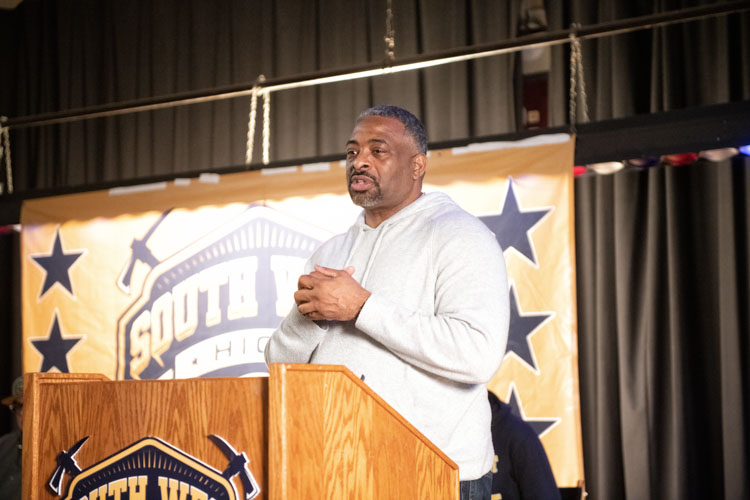
“It made me a much better writer. It made me think outside of just my New York and Detroit bag,” said Reed. “Now I’m writing and thinking, what is this kid in Palm Springs thinking? What are some of the issues that kids really go through in both inner city and suburban neighborhoods?”
Moving forward, Reed wants to continue building his empire, one film at a time. One of Reed’s biggest challenges has been producing films as prices for locations and goods continue to rise. He’s lobbied for Michigan to bring back its film and television incentive program that ended October 1, 2016, but has had no luck. In comparison, Ohio has had a motion picture tax credit since 2009 that provides a 30% refundable tax credit on production cast and crew wages, as well as other eligible in-state spending. Reed has flirted with the idea of moving his operations to Toledo, but says his love for Detroit won’t let him.
“I don’t ever want to move from here. I love being able to create here,” said Reed. “Just being able to be here, to film here, in the winter, be here in the fall…the fall is the most beautiful place ever. It’s nothing like it.”
Related Articles
Summer Bliss Festival Combines Detroit Culture With Community Impact
Summer Bliss Music & Arts Festival celebrates the city’s creative energy through music, art, local businesses, interactive experiences and more, while creating opportunities for artists and giving back to the community.

How Detroit’s East Canfield Art Park merges public art, health data
Sculpture at East Canfield Art Park on Detroit’s east side embeds air quality monitors in public art, providing real-time environmental data for a community living near industrial facilities.
Motown’s Black women songwriters and producers were the invisible architects behind the pop music juggernaut
Few people probably know the female songwriters featured in this article, yet Motown relied heavily upon their contributions to cement its place in music history.