| Follow Us:
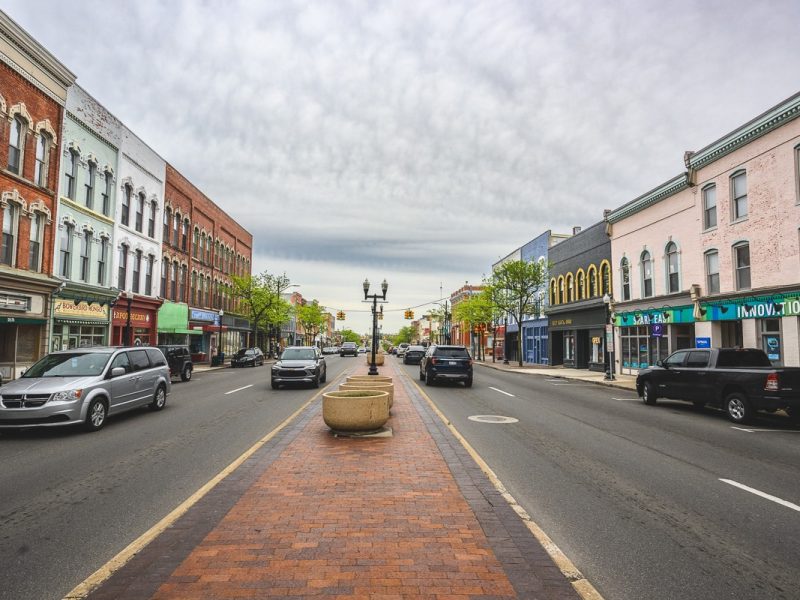
Open air spring evening at Corktown's Mercury Bar - Photo Marvin Shaouni
Open air spring evening at Corktown's Mercury Bar - Photo Marvin Shaouni | Show Photo

Architecture : Detroit Development News

117 Architecture Articles | Page: | Show All

Security Trust Lofts, downtown Detroit's newest housing development, ready to start leasing

Downtown Detroit has some new high-rise housing coming online that has absolutely nothing to do with Dan Gilbert: the Security Trust Lofts at 735 Griswold is a totally-renovated seven-story building located on Griswold at Lafayette, just two blocks south of Capitol Park.
 
The building is owned by Joseph Kalladat, a lawyer by trade who purchased the 1925 Albert Kahn-designed building with the intention of renovating it into loft-style rental units. Because the building had no singular historic relevance beyond its age and attributes, Kalladat had to go through the process of not just designating the building itself as a historical landmark, but the whole surrounding district.
 
With the help of local historic architect Rebecca Savage, Kalladat discovered that this building was part of Detroit's Financial District in the first half of the 1900s. With Savage's help and support, they were able to get the entire district designated as historic – of the 36 buildings in the district, 33 were conforming and now fall under the historic designation.
 
What this means for future development in the area is that developers will receive a 20-percent historic tax credit on renovation work, provided they adhere to historic preservation guidelines. Often old buildings like this sit empty because the cost of renovation is prohibitively high; these historic tax credits help offset the costs.
 
The historic designation process of the Security Trust Lofts started in 2008. Once the designation was received, construction began on the building. It was a complete gut job. "Everything was demolished down to the exterior walls and concrete floors," Kalladat says. Renovation work took about 14 months; now they are putting on the finishing touches and awaiting their final certificate of occupancy. They hope to start moving residents in mid-June.
 
Security Trust Lofts have 19 residential units as well as a clubhouse for residents and a floor dedicated to a fitness center and storage. All lofts come with their own washer/dryer units, stainless steel appliances, granite countertops, dark wood cabinetry, and operable windows. The ground floor and first floor mezzanine will be retail, though they haven't started leasing yet.  
 
Rent ranges $1,275-2,500 and includes gas and water. Units range from loft-style open floor plans to two bedrooms, starting at 850 square feet. Each unit has its own security monitoring system.
 
For information about leasing, call 248-254-4008.
 
Source: Joseph Kalladat, Security Trust Lofts owner
Writer: Nicole Rupersburg

Got a Development News story to share? Email Nicole here.

Stella Cafe remodeled and rebranded as Stella Good Coffee in the Fisher Building

Stella International Café inside the Fisher Building in New Center has gone through a major renovation and rebranding.
 
Now called "Stella Good Coffee," the café – owned by Shawn Santo and Kevin Borsay, owners of Pure Detroit, Rowland Café, a second Stella location inside the Guardian Building, and Vera Jane (a women's clothing store) – will focus on all things Detroit, starting with the design.
 
After closing last fall, the space was stripped down to bare walls and floor, grinding away layers of concrete to reveal the original Albert Kahn-produced floor from 1928 (which has a slightly different design than the floor of the main lobby, also original). Santo and Borsay oversaw all of the renovation work themselves, working closely with James Willer of Reclaim Detroit on material sourcing and design. They also worked with local companies and artists on the fixtures, including lamp shades from the Detroit Wallpaper Company (which will feature the designs of local artists and will be rotated regularly) and a white neon sign that reads "Drink Good Coffee" from Spectrum Neon Sign Company.
 
The redesign also allows for more seating inside the café, which will have free WiFi, and additional seating will be available in the Fisher lobby.
 
In addition to a new look, a new name, and a new logo (a complicated geometric figure with a long technical name that includes the word "stella," also known as the "Moravian star"), Stella Good Coffee will have a whole new approach to their products. Instead of the quick grab-and-go coffee shop they were previously known as, they will offer only pour-over coffees, which take longer but, as Borsay says, "is worth it." They will also have loose-leaf teas, soups from Russell Street Deli, and baked goods from Avalon Breads and Traffic Jam & Snug.
 
Stella Good Coffee is celebrating a "soft" opening this week, with a grand opening coming later this spring.
 
Source: Kevin Borsay and Shawn Santo, owners of Stella Good Coffee
Writer: Nicole Rupersburg

Got a Development News story to share? Email Nicole here.


Neumann/Smith Architecture moving to Midtown, overseeing several major development projects

Neumann/Smith Architecture, which has been around since 1969, has been working under the radar downtown for years. Now, the firm is making it official this year when it moves into the Wright-Kay Building at 1500 Woodward.
 
The firm has worked on several significant projects in the city out of its Southfield office, including various projects with Wayne State University, One Kennedy Square, the Science Center, the $50 million landscape renovation including meditation gardens and fountains at DTE, Blue Cross Blue Shield's east campus (including the green parking deck and courtyard), and work for several clients inside the Renaissance Center.
 
Most recently Neumann/Smith worked with Quicken Loans and Bedrock on some of their most high-profile developments. The first opportunity was the Madison Building, which has become a technology hub noted as much for its design as for its inhabitants. "(That building) was huge for them and for us," says Joel Smith, partner of Neumann/Smith Architecture. "It got a lot of attention." (Particularly the fifth-floor meeting space and rooftop patio available for private parties, which Smith calls "one of the coolest" spaces in the city.)
 
Next up on Neumann/Smith's Bedrock project roster includes renovations of the Dime Building, One Woodward, First National, and construction on the "Z" lot. "With all of this going on we needed to be closer to our client," says Smith. "We have always had a historic preservation practice but the Detroit office will be the hub for historic preservation and adaptive reuse (and) solidify our commitment to the city."
 
The firm is also heading up the renovation of the Wright-Kay Building, which Smith expects to be complete in June. The six floor, red sandstone building will feature office space on the upper floors (fully committed though not yet all officially leased) with ground floor restaurant and retail space.
 
Source: Joel Smith, AIA, partner of Neumann/Smith Architecture
Writer: Nicole Rupersburg

Got a Development News story to share? Email Nicole here.

Designer of downtown's new Crowne Plaza to give the "Pontch" a whole new, colorful look

Another iconic Detroit building, the former Pontchartrain Hotel, will breathe new life later this spring after sitting vacant since 2009.
 
The Pontchartrain will soon re-open as a Crowne Plaza, an upscale hotel property owned by the Intercontinental Hotels Group (IHG). Ohio-based Stephen Berry Architectural Design is the design firm working on the project. The firm specializes in hotel projects nationwide, many of which are IHG properties. The firm has also worked with the previous two owners of the Pontchartrain.
 
Stephen Berry says that the new design concept for the 25-story, 371-room hotel will be sensitive to the building's 1965 modernist design. The vaulted ceiling of the lobby will be completely re-finished with gold and silver leaf. The restaurant and lounge spaces will be totally re-imagined with copper leaf accents, new fixtures and décor.
 
"The lobby and lounge will be very modern and striking. We're really changing the look," says Berry. "(The new design) really gets away from the darkness of the past."
 
The exterior of the building will also see significant aesthetic changes with a whole new color scheme. The face of the building will be neutral beige with green glass. One of the biggest changes includes a new auto-access entrance on Jefferson in IHG's signature plum color, with a white custom-built backlit canopy arcing over it. "It's very colorful. The building was always a monochromatic black and dark gray. Now it will have a whole new look."
 
Significant work is also being done to the second-floor exterior terrace, which Berry describes as a "key feature of the building."
 
Other plans include added ground-floor retail along Jefferson, including a new gift shop concept that internationally-known hotel developer Gabriel Ruiz (who is behind this development) has branded in his hotel chain through North America.
 
Source: Stephen Berry, owner of Stephen Berry Architectural Design
Writer: Nicole Rupersburg

Got a Development News story to share? Email Nicole here.

David Whitney Building secures final $8.5 million in funding, will begin construction immediately

A recent $8.5 million investment by the State of Michigan in the David Whitney Building has made headlines recently. This money finally enables the Whitney Partners, LLC to move forward with construction.
 
The Whitney Partners are the Roxbury Group, the Detroit-based real estate development and consulting firm that is heading up this renovation project and most recently completed the Auburn, a new construction project in Midtown, and Troy-based investment firm Trans Inn Management Inc.
 
"The $8.5 million is coming as a loan being lent to us through the Michigan Community Revitalization Program," says David Di Rita, owner of the Roxbury Group. "It is enormously important. It closed the remaining funding gap between all of the other credits and incentives."
 
So far the project has received $9.8 million in a state brownfield redevelopment tax credit and $12.4 million in state historic tax credits. "We still had about $8.5 million to bring to the deal to get financing closed and that’s what this will do. It was the final piece."
 
At press time the Whitney Partners were working to close on overall financing for the project. Construction will start immediately once the funding is in place.
 
"We won’t be announcing when we close the financing deal," Di Rita says. "We will just start construction and that’s how people will know."

So keep an eye out for those construction cranes.
 
The David Whitney Building has sat empty since 2000. The Roxbury Group bought the building in 2011 for $3.3 million. The renovation will create 105 residential apartments, a 136-room Aloft Hotel (a Starwood Hotels & Resorts Worldwide property), a new and improved People Mover station, and ground floor retail.
 
"We’re very proud of the fact of being able to (secure funding) within 24 months of getting the building," says Di Rita.
 
They are targeting early 2014 for full completion of the project, which is expected to cost $82.5 million and create 75 jobs.
 
Source: David Di Rita, Owner, The Roxbury Group
Writer: Nicole Rupersburg

Have a Development News story to share? Send Nicole an email here.

U-Haul installs new sign, lighting in its New Center home

Perhaps you have seen the new sign atop the building U-Haul is renovating into its latest full-service location? Or a few of the upper floors lit up at night showing off doors painted in bright orange while driving by on the Lodge Freeway? If so you have seen the most recent progress of one of the greater downtown Detroit area's largest redevelopment projects.

The moving company bought the former Nabisco Building in New Center (899 W Baltimore St.) last summer and has been slowly but surely rehabbing the 250,000-square-foot structure into its first full-service center in Detroit. The new location, set to open this spring, will feature everything from truck and trailer rentals to storage space.

"One year from now we will have a gorgeous truck, trailer and storage business going there," says Stuart Shoen, executive vice president of U-Haul. "I am just very optimistic for the area."

For now, Detroiters are going to have to settle for the encouraging new visual cues on the building's crown and updates from the company's blog about the work. Workers (three U-Haul employees and about 20 construction workers) are currently focusing on finishing the renovation of the showroom and getting the basics of the rest of the building to come on.

"It's finally starting to look like a retail space," Shoen says. "The building needed a lot of fundamental improvement. It took us longer to get the water and the electricity on than we thought. The windows weren't level in the showroom. This building needed a lot of work in every facet."

National Biscuit Co (or Nabisco today) built the structure in the 1920s as a bakery. It has been vacant for several years before U-Haul purchased it to service Detroit's growing population.

"In a few years, we will be contemplating building more," Shoen says. "That's our hope and expectation."

Source: Stuart Shoen, executive vice president of U-Haul
Writer: Jon Zemke

Read more about Metro Detroit's growing entrepreneurial ecosystem at SEMichiganStartup.com.

Downtown Hamtramck makes National Register of Historic Places

Downtown Hamtramck is now a part of the National Register of Historic Places, a designation that should help the commercial district leverage more redevelopment dollars and maintain its classic character.

The historic district runs the length of Jos Campau Street between the GM Poletown plant to the south and close to Carpenter Street on the north end. "The historic district is a couple of streets short of that," says Jason Friedmann, director of community and economic development for the city of Hamtramck. "This is the area with the oldest buildings with the most character are located."

The Jos Campau Historic District encompasses about 200 buildings that are about 100 years old. Most of the them were constructed after the old Dodge Main Plant was built in the early 1900s. It joins the historic district around St. Florian Catholic Church near the intersection of Jos Campau and Holbrook streets.

The Jos Campau Historic District is only a national historic district. That designation allows it to leverage national historic tax credits for redevelopment but doesn't come with the strict restrictions and oversights commonplace in local historic districts.

Source: Jason Friedmann, director of community and economic development for the city of Hamtramck
Writer: Jon Zemke

Read more about Metro Detroit's growing entrepreneurial ecosystem at SEMichiganStartup.com.

New three-story glass atrium at Cobo Center debuts at the Auto Show

The new Corvette Stingray isn’t the only thing that will be making its public debut at the 2013 North American International Auto Show.
 
The Detroit Regional Convention Facility Authority is busy at work on a $300 million renovation project at Cobo Center. The extensive plans include a three-story atrium with a skylight and an 80-foot glass wall on the structure's southern exposure overlooking the Detroit River.
 
"What was formerly a confined dark space is now flooded with bright light," says Patrick Bero, CEO of the Detroit Regional Convention Facility Authority. Cobo Center first opened in 1960, long before the Riverwalk was built, and was originally designed with no direct link to the River itself. "There was no direct link to the region’s most vital asset. The biggest function of the atrium is that it is our connection to the river."
 
The atrium offers 16,000-square-feet of space that will accommodate 600 people for dinner, 1,000 people in theatre-style seating, or 1,200 standing. The space is intended for high-profile VIP events and other special occasions. The glamor of this new event space is enhanced by 30,000 square feet of porcelain tile from Italy, 315 tons of marble from Portugal, and 19,000 square feet of glass from Michigan-based Guardian Industries. "The biggest thing is the striking view the atrium gives us of the Detroit River," says Bero. "It also gives us another point of entry into the facility." The atrium can be accessed from the Riverwalk by crossing Atwater St.
 
The atrium will temporarily open for the Auto Show, which opens to the public on Jan. 19. It will then close again in order to complete construction.
 
In addition to the atrium, the former Cobo Arena is being renovated into a grand ballroom and several meeting rooms. The grand ballroom will feature 40,000 square feet of space with 40-foot ceilings, dinner seating for up to 2,500, two industrial lift elevators in the floor (for auto "reveals"), and an outdoor plaza extending around the perimeter. Upgraded garages on Congress St. and Washington with additional parking spaces, a new all-natural concessions venue on the main concourse, an expanded kitchen with private tasting room, and a new food court round out the extensive list of renovations.
 
The full renovation is expected to be completed in June. 
 
Source: Patrick Bero, CEO of the Detroit Regional Convention Facility Authority
Writer: Nicole Rupersburg

Have a Development News story to share? Email nicole@modeldmedia.com.

Shelborne begins transformation of New Center apt district

Shelborne Development is in the midst of rehabbing two significant historic apartment buildings in New Center and is set to transform the block of Seward Street between Woodward and Second avenues with renovations.

The renovations promise to turn some of the biggest, blighted structures in New Center into vibrant buildings filled with new residents. When it's all said and done, the rehabs will bring well in excess of 100 new rental units to the northern tip of the greater downtown area.

"I have always loved that block of Seward," says Kathy Makino-Leipsitz, co-owner of Shelborne Development. "It is one of the prettiest blocks of multi-units in the city. Hopefully, we will be able to turn that block into what it used to be."

The Indian Village-based development firm is the driving force behind the renovation spree taking place in Palmer Park. Its rehabs have expertly leveraged tax credits and other incentives to turn the Art Deco beauties into high-quality rentals that include energy-efficient systems and appliances, insulation, stainless-steel appliances and granite countertops, among other amenities. These rehabs go the extra mile to preserve the historical character of the buildings, which are often chosen in large part because of the architectural beauty.

Makino-Leipsitz plans to do the same thing with at least half a dozen of the apartment buildings in New Center, most of which are vacant and have fallen into disrepair. The first two, which are currently under renovation, are 112 Seward and 628 Delaware.

The apartment building at 112 Seward is called the Birchmont Apartments. It stands as a 3.5-story building with a blond-brick facade and is just east of the 120 Seward condo building. It will house 31 units that include 1-, 2-, and 3-bedroom apartments. 628 Delaware is a tudor-style structure that stands four stories overlooking New Center Commons Park just west of Second Avenue.

"That Delaware apartment building is a beautiful building," Makino-Leipsitz says. "It will be 18 units when we're done."

Both buildings, each about 100 years old, are set to come online in August and fully occupied by the end of the year. They will bring 49 units of workforce housing to the rental market. The buildings previously housed 54 units. The developers redesigned the units to offer bigger spaces with more rooms.

Shelborne Development also owns 59, 69, 90, 93, and 100 Seward, which are all high-density apartment buildings on the first block of Seward west of Woodward. The firm has already renovated 93 Seward and plans to renovate 90 and 100 Seward as market-rate rentals next. It recently acquired 59 and 69 Seward, which have long been problem buildings with out-of-town ownership, and plans to renovate those, too, within the next few years.

Source: Kathy Makino-Leipsitz, co-owner of Shelborne Development
Writer: Jon Zemke

Read more about Metro Detroit's growing entrepreneurial ecosystem at SEMichiganStartup.com.

More Palmer Park apts set to come online in Feb, April

Renovation work on a handful of apartment buildings in Palmer Park is set to wrap up in the next few months.

The first in line for completion is the Sarasota Apartments, 325 Merton, in February. The four-story building exemplifies the Art Deco architecture for which Palmer Park's apartments are famous. It had been vacant for years, falling into disrepair before renovations began last spring.

Next in line are the Seville Apartments and Palmer Lodge. Both are set to come online in April. "I really can't wait," says Kathy Makino-Leipsitz, co-owner of Shelborne Development which is heading up the development of the apartment buildings in Palmer Park.

Palmer Lodge
is one of the marquee apartment buildings in the Palmer Park historic district. The jumbo-sized Tudor-Revival structure stands sentinel at the corner of Woodward Avenue and Covington Drive. The four-story apartment building was designed by Weidmaier and Gay and built in 1925. It's being redeveloped into 54 apartments and space for two businesses (think cafe or martini bar) in its basement. The Seville Apartments is at 750 Whitmore St. The four-story structure at the corner of Third Avenue and Whitmore Street will feature 16 apartments. One hundred and two units will come onto the market when construction is finished at all three, which were vacant and in serious disrepair before renovation work began early last year.

Shelborne Development is renovating these buildings and a handful of others in Palmer Park. The Indian Village-based firm leveraged historic tax credits, federal stimulus funding and other government incentives to renovate these buildings to maintain their historic integrity and upgrade them with modern conveniences such as new Energy Star appliances, high-efficiency furnaces, insulation and granite countertops. It previously renovated the La Vogue apartments last summer.

Makino-Leipsitz says she is still pursuing the idea of bringing mounted security patrols to the neighborhood by utilizing the Detroit Police Department's mounted division, which is housed nearby. She also wants to bring Christmas lights to the trees of the neighborhood to help inject some vibrancy to the area.

"I want to light up the trees in Palmer Park like they do at La Dolce Vita (a nearby restaurant)," Makino-Leipsitz says. "It gives the area such a great feel."

Source: Kathy Makino-Leipsitz, co-owner of Shelborne Development
Writer: Jon Zemke

Read more about Metro Detroit's growing entrepreneurial ecosystem at SEMichiganStartup.com.

Slows expanding, adding more seats and offerings

Detroit’s most famous restaurant is currently going through a much-needed expansion.
 
Slows BAR BQ, which has been covered in national media from the New York Times to Food & Wine and was a 2012 finalist in Adam Richman’s Best Sandwich in America on the Travel Channel, is largely credited with kick-starting the rebirth of Corktown, attracting several new independent businesses on its block of Michigan Avenue and leading to what is now a total lack of available rental units according to Ryan Cooley, co-owner of Slows and owner of O’Connor Realty.
 
The original Slows space, which seats about 80 indoors (not including the seasonal outdoor patio), was ill-equipped to handle large parties, and long wait times inside the enormously popular restaurant inevitably led to a lot of bottle-necking at the front door by the bar.
 
"We're adding on the new space but it will serve as more a beer bar, private dining room and waiting area," Cooley says. "With bigger parties this is really going to help with efficiencies."
 
The new 1,200-square-foot space, which is overtaking the former office of O’Connor Realty (which has since relocated down the block), will be connected by a door to the original location but will in effect be its own separate space ideal for private parties and grabbing a drink while waiting for a table.
 
The new bar will feature 36 tap handles, many of which will be duplicate selections from the bar in the main restaurant for efficiency’s sake. The beer cooler will be expanding and moved into the basement, freeing up additional space upstairs.
 
Behind the scenes, the kitchen will also be expanding into the new space and will be fully updated. "We opened on such a shoestring budget the first time through we had to buy used equipment. This will allow things to be more streamlined," Cooley says.
 
This is good news for serious barbecue enthusiasts, as this will enable Slows to slow down their smoke times and make a good product even better. Chef and co-owner Brian Perrone will also be able to host more beer dinners and run additional specials, allowing him more creativity in the kitchen.
 
Cooley says that by the time the kitchen is expanded and bathrooms added, the new space will add about 20 new seats. "We didn’t want to add to ton of space, really. We didn’t want a huge open-feeling space. We kind of wanted to keep it small and intimate."
 
At press time the main restaurant is on track to re-open on their target date of Jan. 9, while the new space may be delayed just a day or two.
 
Source: Ryan Cooley, co-owner of Slows
Writer: Nicole Rupersburg

Detroit Institute of Bagels breaks ground on new production facility

Back in 2010, Ben Newman had a dream of better bagels for Detroit. He and his brother Dan launched Detroit Institute of Bagels out of their flat in Corktown, selling unique bagel flavors like bacon cheddar and rosemary-olive oil-sea salt made to order. The bagel buzz built quickly; a Kickstarter campaign raised about $10,000 towards their own bagel shop and they were top ten semi-finalists in the first-ever Hatch Detroit competition in 2011. When they purchased a building on Michigan Avenue in Corktown roughly one year ago, it seemed that Detroit’s days as a bagel desert were coming to an end.
 
But as anyone who has tried to renovate a historic and long-vacant building can tell you, these things take time.
 
"Anything going from idea to reality takes two years, (that’s) what everyone told me," says Ben Newman, co-founder and bagelsmith of DIB who also has a Masters in Urban Planning from the University of Michigan.
 
Since Model D reported on the purchase of the building at 1236 Michigan Ave., the Newmans have received Rehabilitation Tax Credits, but weren’t allowed to do any sort of renovation work on the building during the approval process. The building itself has, at their best estimate, sat vacant for roughly 40 years before they acquired it, and when they began to look at the basement as the bagel production facility they quickly realized it wasn’t going to be practical and a new production facility would have to be added on.
 
"(We were told) we might never be able to fully waterproof the basement and end up tens of thousands of dollars into trying and still be forced to build a new space," Newman explains. "For the employees, for myself, for the experience and overall efficiency it will be better to have all production happen on the same floor as the retail."
 
DIB broke ground Jan. 3 on its new bagel production facility, which will be located in the space between the current building and PJ's Lager House (sharing walls with both). The 1,800-square-foot new building will be set back about 30 feet from Michigan Avenue. The rest of the street-facing lot will be a green space with outdoor seating. Inside there will be windows between the café and the production facility which will allow customers to watch the process of bagels being made.
 
Renovation on the original building hasn't yet started, though now that ground has broken on the new facility all of the construction will move forward simultaneously.
 
"That was part of the year-long process," Newman says. The structural plans and mechanical drawings for both buildings had to first be completed, submitted and approved before any significant work could be done.
 
While their initial hopes of opening in 2012 were perhaps a bit too ambitious, Newman remains undaunted and continues to move forward. "I am really happy that people are excited about our opening. I realize that it's a very good thing to have a following before we open," he says. “We’re not just opening a bagel shop (in) a white box space; we’re redeveloping a whole property. For me that’s what I’m passionate about."
 
Source: Ben Newman, co-founder of the Detroit Institute of Bagels
Writer: Nicole Rupersburg

Gilbert's downtown footprint expands with new purchases

The Dan Gilbert game of downtown Detroit Monopoly is not showing any signs of slowing down these days. The chairman of Quicken Loans acquired five more buildings just before the end of last year and now there is a report from Crain's Detroit Business that he has his sights set on more.

What we know is that Gilbert's real-estate company, Rock Ventures, recently acquired five buildings on Woodward Avenue and Broadway Street. These largely vacant buildings include the addresss 1201, 1217 and 1412 Woodward, along with 1301 and 1521 Broadway.

"We didn't want to see these buildings just sit there and have no activity in them," says Jim Ketai,  managing partner of Bedrock Management, Gilbert's real-estate management firm. "We want to bring some more activity to them."

Gilbert now owns 15 buildings with 2.6 million square feet of commercial space and another three parking garages with 3,500 spaces. His firms are also building a new parking garage/retail space on Broadway and are leasing space in the Compuware Building.

The latest additions include a former Kresge department store at Woodward Avenue and State Street and the building that houses Small Plates next to the Detroit Beer Company. All of the buildings will be renovated to accommodate ground floor retail space and either residential or office space above.

"It will take a lot of time," Ketai says. "They have had a lot of neglect."

Source: Jim Ketai,  managing partner of Bedrock Management
Writer: Jon Zemke

Read more about Metro Detroit's growing entrepreneurial ecosystem at SEMichiganStartup.com.

Top development news of 2012 spread across Motor City

There was no no shortage of big announcements in Detroit's built environment in 2012, so Model D has expanded its Top 5 Development News Stories to its Top 5 Development News Subjects. This year's list includes:

The Gilbert Effect
Quicken Loans Chairman Dan Gilbert became the biggest power player in downtown Detroit this year. His team's accomplishments include acquiring buildings left and right, filling them with tech businesses, pushing for a retail rebirth in the Central Business District and spearheading the M-1 Rail plans for light rail up Woodward which now seems quite likely with the passage of a regional transit authority bill in the state legislature.

Palmer Park Rebirth
The Palmer Park area - ahem, Uptown - is enjoying a large amount investment these days as the quality of life improves with more community involvement. Shelborne Development is spearheading the renovation of a number of Palmer Park's Art Deco apartment buildings, including La Vogue and Palmer Lodge, and working to establish mounted security patrols. Local residents are improving the area by planting sunflowers along Woodward Avenue, planting orchards in Palmer Park, building trails through the park and rebranding the area Uptown.

Downtown/Midtown Apt Blitz
Developers can't build new living options in Detroit's downtown or Midtown neighborhoods fast enough these days to keep up with skyrocketing demand. Some big projects came online in 2012, including the Broderick Tower, The Auburn and Newberry Hall. More are coming. Construction is in progress for the Sherbrooke Apts and Woodward Garden Block Apts and work is set to begin on the Whitney Building in a few weeks.

Momentum in The Villages
The people working to improve the The Villages scored some big wins in 2012. Those wins include developing plans for more greenways, sparking the pop-up retial store boom, Tashmoo Beirgarten's return, and landing a number of new businesses to take those spots in West Village. Look for The Villages to keep the momentum going in 2013.

Wayne County Tax Foreclosure Auction
This year set the record for the Wayne County Tax Foreclosure Auction. This fall's auction featured more than 20,000 properties and sold more than 12,000. Local officials are working to turn these empty houses into new homes. What happens next to the thousands of unsold properties is becoming a bigger question that needs to be dealt with. Oh, and next year's auction is set to break all of those records again.

Honorable-mention projects include, Avalon's expansion plans, Buffalo Wild Wings moving downtown, the groundbreaking of WholeFoods, Reclaim Detroit's deconstruction efforts and the GAR Building rehab.

Writer: Jon Zemke

Read more about Metro Detroit's growing entrepreneurial ecosystem at SEMichiganStartup.com.

Hamtramck partners with Reclaim Detroit on home deconstruction

Hamtramck is taking a lead role on Metro Detroit's fledgling home deconstruction industry. The inner-city suburb commissioned one of the first deconstructions last year from Reclaim Detroit and now has six more in the offing. The city is also applying to have another 40 homes deconstructed through the Michigan Land Bank.

Home deconstruction is an alternative to demolition for buildings beyond repair and renovation. When a building is razed, it only takes the efforts of a handful of unskilled workers and all of the byproducts goes to a landfill. Deconstructing a building creates more jobs (about 10-12 for a single-family home) and ensures that a vast majority of the building's materials are recycled.

"That's something we have been pursuing for a while," says Jason Friedmann, community & economic development director for the city of Hamtramck. "It helps keep the valuable materials out of a landfill. Some of these materials can't be found anymore, no matter what the price, like the old-growth lumber."

A house on Carpenter Street was one of the first to be deconstructed by Reclaim Detroit. That project created 18 jobs and the materials from it generated $40,000. Some of those materials ended up in places like the Great Lakes Coffee Roasting Co cafe in Midtown.

The 40 homes in line for deconstruction next year are a combination of leftovers from last fall's Wayne County Tax Foreclosure Auction, city-owned houses beyond repair and privately owned homes that are either condemned or fire-damaged and have no insurance. Friedmann hopes to leverage the current six deconstructions set to happen this winter and 40 next year to help create more jobs in the city.

"A lot of skills that can be used to take apart a building can be used to put one back together," Friedmann says.

Source: Jason Friedmann, community & economic development director for the city of Hamtramck
Writer: Jon Zemke

Read more about Metro Detroit's growing entrepreneurial ecosystem at SEMichiganStartup.com.
117 Architecture Articles | Page: | Show All
Share this page
0
Email
Print
Signup for Email Alerts