Making Moves on the Near East Side
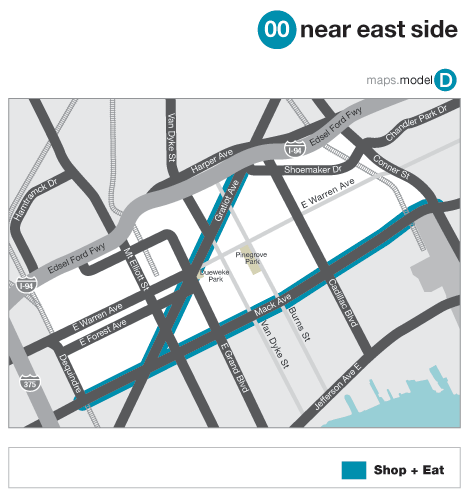
The area immediately east of Midtown and Downtown was once home to thousands of common folks – people who lived in small homes in tidy neighborhoods and worked in the largely industrial area. They shopped on Gratiot, Mack, and Jefferson avenues, frequented neighborhood markets and corner bars, and spent their leisure time in the many local parks, or went to the riverfront and Belle Isle.
Today, several of those old neighborhoods have stabilized and some former residents or those familiar with the neighborhood, are returning. Community development organizations are mobilizing human and financial resources to revive the area, based on its assets.
It is a place with good schools and parks. It is a place of faith, where churches create a sense of purpose, feeding the spirit of the city. These are churches with a commitment to the soul of a place, to redeveloping their surrounding neighborhoods and to proving that faith will carry folks further yet.
In a report prepared for the Community Foundation of Metropolitan Detroit community stakeholders identified several strengths in the Near Eastside:
• Resilient, long-term residents
• Proximity to the Detroit riverfront, downtown, and Midtown area
• Freeway access and other major roadways for commercial development
• Concentration of civic, cultural and educational institutions
• Eastern Market as a neighborhood and regional resource
• Neighborhoods with history and attractive housing
• Parks, open spaces, riverfront and greenway plans
• Diverse schools offering educational choices
• Network of non-profit organizations committed to neighborhoods
• Land for development
The most important asset of the Near Eastside is its people. Many of the people who have chosen to live in the Near Eastside are resilient yet hopeful. They have invested their energies in community activism, evidenced in organizations such as Mack Alive, in which residents take to the street in positive affirmation of their commitment to the community. Some are dedicated to their historic districts, such as Indian Village and West Village, as well as the historic Lafayette Park, the nationally recognized example of modern 20th century residential architecture.
About half of the students at Friends School in Detroit come from the Near Eastside, says Headmaster Dwight Wilson. “The people are kind. They will speak to you. One on one, people here are real,” Wilson says. “They come to the school, they support their kids, they cheer their kids. It’s a wonderful place.”
A stabilized community
Despite population loss on the Near Eastside, stable long-term residents have remained. They continue to care about their neighborhoods and expect to see them regain population as the City of Detroit recovers economically. Historic neighborhoods such as Indian Village and West Village have appreciated in value. Along the western edges of the area and along the riverfront, the population has already increased or is expected to increase as new development planned adds residential density.
Generally, the income of people in the Near Eastside is lower than elsewhere in the city, according to the Community Foundation study. More seniors in the area also live below the poverty line. While a majority of the residents have completed high school, a fair number have not and few have a college education.
Community-based neighborhood development
One of the more vibrant communities experiencing a renaissance is Gratiot Woods. Located in the middle of the northern boundary of the Near East side, the neighborhood has experienced residential development, park and streetscape improvement, and is poised for commercial development along Gratiot. However, the resiliency of the people living there and the return of those who once lived there, or knew people living there, is recreating a community, says Cleophus Bradley, director of Community Development for the Detroit Catholic Pastoral Alliance and former resident of the area.
African Americans remember it as one of the first racially integrated neighborhoods of Detroit. “When they had a chance to better themselves, they moved into a neighborhood like this,” Bradley says. “It’s like home for a lot of people. It’s their roots.” Some seniors want to stay in an apartment setting; others are waiting for residential opportunities to return. The Alliance will break ground on its newest residential development, a 62-unit senior apartment building. The agency’s development is driven in large part through consensus derived through community meetings.
Gratiot Woods is home to an urban 4H Center and park. An estimated $500,000 has been invested in the 4H Park and urban garden, 300 trees provided through partnership with Greening of Detroit, and other landscape improvements, according to Christopher Bray, director of the Alliance’s Housing and Development.
The Near Eastside is green
There are nearly 24 parks in the area, not including Belle Isle, Tri-Centennial Park, or the Dequindre Cut greenway under development. The Near Eastside is green, with the potential of becoming greener. Larger-scale open space improvement – highlighted by the refinement of Belle Isle – is having a powerful impact on how the area as a whole is viewed. There is an opportunity for building upon the longstanding but under-used green assets in neighborhoods where they are located. Some of the smaller-scale parks are not easily accessible to pedestrians.
The presence of existing green spaces is an important physical amenity to improve and build upon as neighborhood revitalization and community building plans are put in place. These smaller open spaces provide part of the physical infrastructure needed to realize broader plans for a green community that is enhanced by new pedestrian and biking connections to new parks. However, fiscal pressures on the city have limited its ability to maintain the parks, challenging community groups and private interests to adopt green spaces.
Related Articles

Juneteenth: Freedom’s promise is still denied to thousands of blacks unable to make bail
Just as with so many other criminal justice policies, pretrial detention disproportionately affects African-American men and women, destabilizing black families in the process.

Michigan Adventurer to Bike 1,000 Miles Across State to Spotlight Hidden Form of Domestic Abuse
A Michigan adventurer is biking over 1,000 miles across both peninsulas this summer to raise awareness about economic abuse: a hidden form of domestic violence that affects countless survivors across Michigan.

Detroit schools are making real gains in reading and math: 4 strategies that are working
The city’s schools are making progress faster than peer districts, but that progress could be fragile.