Heidelberg Turns 21
This
week in Model D, Walter Wasacz talks with artist Tyree Guyton
about the Heidelberg Project, 20 years later, and photographer Dave Krieger
looks at colorful houses and outdoor installations that have attracted
the art world’s
eyes to Detroit.
Ed.’s Note: Also check out Dave Krieger’s photo essay on the art of Heidelberg Street. Click here.
Tyree Guyton is taking it all the way. His life is now entirely devoted
— he’s telling a small group of fans, friends, journalists and official
members of the Heidelberg Project family who are gathered on the sidewalk in the neighborhood where he lives and works — to making art that can change the world.
“There
is great power in helping to transform a place, or transform the way
people think,” Guyton says. “I asked myself, ‘What can I do to bring
about real change that affects the lives of real people?’ My answer is
this you see all around us.” He’s looking up, down and across
Heidelberg Street, where over the past 20 years Guyton has been
assembling Detroit’s most acclaimed — and maligned — installation of
art.
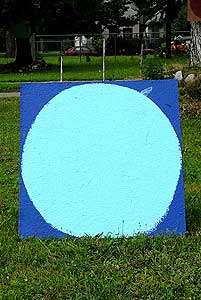 Guyton’s colorful construction has been multiplying
across Heidelberg Street, an east-west residential street south of Mack
and east of Mt. Elliott on the city’s old eastside, and onto nearby
streets like Elba and Ellery, since 1986. As much an ode to hope as it is critical commentary on the breakdown of community in one of America’s great cities,
the work includes paintings on nearly every available surface —
including televisions, tires, old car parts, lockers, utility poles and
houses — trees stuffed with toy animals and shoes and polka dots
everywhere. Many of the newer paintings are what Guyton calls his Faces of God
series. The faces depict people of all races, in all colors, with red
hair, black hair, teeth clenched in anger, or expressions beaming with
joy.
Guyton says the religious thread in his work initially came from an experience he had when he was about 30 years old.
“I
had a vision, a greater power talked to me,” says Guyton, 50. “I
stepped out of that house, across the street on Heidelberg, and heard
God calling to me. I thought
I’d lost it. But I saw the project unfolding before my eyes.”
That
moment of inspiration came in 1986, the same year the Heidelberg
Project was launched. To celebrate two full decades of Guyton’s work on
this monumental piece a commemorative anniversary festival is being
held this Saturday on — where else? — Heidelberg Street.
Called Connect the Dots, the event begins at 2 p.m. and will feature
music by Soul Clique and Underground Resistance DJs Konspiracy,
Di’jital and Skurge. Other highlights include the Kids of Heidelberg,
the Casa Maria Drumline and Duffield Elementary School’s back-to-back
National Chess Championship team. There will also be food and beverages
onsite.
Everyone attending will be asked to wear an official Heidelberg polka dot t-shirt and pose for the 20th anniversary photograph.
Politics and drama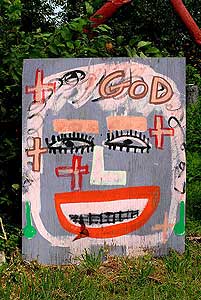 The
The
celebration will be well earned. The 20-year history of the Heidelberg
Project has been marked by countless accolades from critics and fans of
outsider art around the world — but tempered by pitched political and
court battles at home with Detroit leadership.
Two years after
Guyton began assembling Heidelberg, the project received national press
in Newsweek and People magazines. In 1989, he was granted the city’s
“Spirit of Detroit” award and a year later he had a one-person
exhibition at the Detroit Institute of Arts. But soon after Guyton
appeared on the Oprah Winfrey Show in 1991, four houses that were part
of the Heidelberg Project were demolished by order of then-Mayor
Coleman A. Young.
Guyton says he told Winfrey that the project
should remain outside, and not become an “inside” museum. “I don’t know
if Coleman took that as a challenge, but he sent the demolition crews
in right after that.”
A year later, Guyton received the Artist
of the Year Award from Gov. John Engler, and during the next five years
traveled with pieces of the growing installation to shows in Minnesota
and Germany. A Heidelberg photo exhibit also worked its way around
Europe.
Guyton and Heidelberg executive director Jenenne
Whitfield initially found a sympathetic response to the project from
Young’s mayoral successor, Dennis Archer. In 1997, Guyton and Whitfield
received a $47,500 grant from the City of Detroit Cultural Affairs
Department for the development of a café and welcoming center. But soon
after, some members of the City Council threatened to close down the
project.
Many of the threats came from councilmember Kay
Everett, who said, “I want it gone. I’d put on a hard hat and drive the
bulldozer myself if the project is still up when we come back from
recess.” Guyton and Everett even sparred verbally about the project on
Court TV. A city administrator, Public Works Director Clyde D. Dowell,
called Heidelberg “an illegal dump site and will be handled in that
manner.”
In 1998, despite receiving 275,000 visitors that year,
Guyton had to thwart plans by the city to demolish the project by
getting a restraining order. But a year later, the restraining order
was lifted and Archer sent bulldozers back to Heidelberg Sreet. Another
part of the installation was taken down.
Whitfield says that the
energy the City of Detroit spent trying to “squash the project … shows
how powerful art can be.”
Traveling the world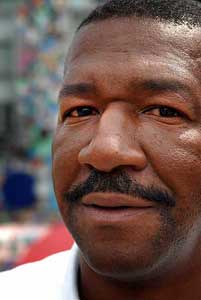 In the past five years, a renewed missionary zeal has also been evident. Guyton created an off-site installation, called “Open House,”
at the DIA for Detroit’s 300-year anniversary celebration in 2001; and
he was commissioned by the city to build an “art-garbage truck” for the
2002 Thanksgiving Day parade. Guyton and Whitfield have traveled around
the world, including two trips to Ecuador, lecturing about Heidelberg
or installing works. Pieces of the work have been exhibited at shows at
Harvard University and Pittsburgh’s Three Rivers Art Festival. In 2004,
Heidelberg was part of the Shrinking Cities exhibition in Berlin.
But just as often, or more, the world comes here to see Guyton’s vision made real.
While
Guyton, Whitfield and festival director Aku Kadogo were talking on the
sidewalk in front of the Heidelberg home that has belonged to
Guyton’s family for three generations, a young visitor from New Orleans
stepped up to introduce himself.
“I never knew this existed,”
Clay Smith says. “I’m in Detroit for the first time ever. I just got
here and I can’t believe what I’m seeing.”
Guyton pointed to an
inscription in Hebrew made on the street by some recent visitors from
Israel. He nodded in another direction to a spot where some fans from
England pitched a tent one night and camped next to paintings,
sculptures made from tree trunks, and clusters of dolls and shoes.
“It
sounds like a cliché, but it’s the power of the people that has kept
the Heidelberg Project alive and moving forward,” Whitfield says.
“It’s
all about the people, who deserve a better community and a better
world,” Guyton says. “In my own way, I’m trying to make that happen.”
The
Connect the Dots festival will take place on Heidelberg Street, between
Mt. Elliott and Ellery, Saturday Aug. 26. To make a donation to the
Heidelberg Project’s 20th anniversary festival or obtain an official
polka dot-shirt, go to www.heidelberg.org or call the Heidelberg Project office at 313-267-1622. The first group photo will be taken at 3 p.m.
All Photographs of the Heidelberg Project and Tyree Guyton Copyright Dave Krieger
Related Articles
Returning citizens face extra hurdles in Detroit’s already challenging housing market
Formerly incarcerated people face numerous challenges in finding housing, often leading them to become homeless or recidivate.
CDFIs investments in childcare allows daycares like Detroit’s Lil Love Bugs to further invest in children’s futures
Childcare is not a family issue, but a workforce issue. Members of the MI CDFI Coalition showcase how investing in quality, affordable childcare and early childhood education positively impacts the entire community.

Partner Partner Content Don’t Let Fraud and Scams Ground Your Summer Vacation
Planning a summer getaway? Before you book, learn how to spot common travel scams and protect your money so your vacation stays stress-free.