Less Can Be More
Detroit
is losing population, but gaining opportunities to re-shape its future.
Architect Francis X. Arvan says vision, hope and reality must get on
the same page to make it sustainable.
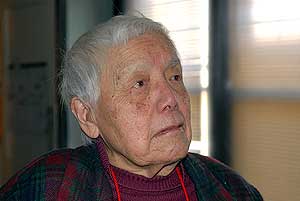
Grace Lee Boggs’ vision for Detroit trumps mundane reality. The
92-year-old community activist — who has been a voice for social
justice and a proponent of civil and women’s rights since the 1940s —
believes the 1967 riot was the first realization that Detroit’s
industrial might was on a downhill slide.
 In a recent panel
discussion on the future of the city, Boggs talked of the violence that
erupted on 12th Street as the inevitable result of the city’s
deindustrialization, and by the loss of jobs first felt by young black men
in a city where for decades a living wage was available to nearly all
who wanted it. Since that time Detroit has struggled to find a new
reason for being. Former Mayor Coleman Young promoted General Motor’s
Hamtramck Assembly Plant — a project perhaps best known for the city’s
use of eminent domain to raze the Poletown neighborhood — to stem the
tide.
Casinos have been proposed
(and eventually built) to keep jobs in the city. Yet, despite these
grand efforts the jobs and the tax base keep leaving. The latest blow to the
city’s fragile business infrastructure came when Comerica Bank
announced earlier this month it was leaving the city after 150 years to
relocate its headquarters in Dallas. Like many industrial cities,
Detroit is shrinking. But none, perhaps, have received as much
attention in its decline as the greatest production city
the world has known.
New paradigms
As
part of the ambitious and relevant Shrinking Cities exhibit now up at
the Museum of Contemporary Art Detroit (MOCAD) and Cranbrook Art Museum
some 100 people attended the discussion organized by Mitch Cope,
Co-Curator of Shrinking Cities and moderated by Kathryn Underwood from
the Detroit City Planning Commission. It was held in the rough-hewn
space of MOCAD’s central gallery. The panel included the
aforementioned Boggs, Anika
Goss-Foster of Mayor Kwame Kilpatrick’s Next Detroit project,
Greg Parrish from Detroit’s Planning and Development Department and
Dorian Moore from the Archive Design Studio architectural firm.
 The
The
irony was palpable throughout the evening. The line was drawn between a
visionary’s call for a new paradigm free of big business and the
reality of a city planner focused on building back a city, hoping
for private development and promoting mixed-use nodes whenever possible.
Some
audience members made the nut of the issue very clear. If we build it
why should they come? How can Detroit rebuild a city without the
necessary jobs? People come to a city not because of the buildings;
they come because there is a viable and safe community, there is a rich
vibrant culture and … jobs.
Facing this honestly, Greg Parrish
admitted that traditional planning tools are not well equipped to deal
with these questions. I commend his non-rhetorical candor. The reality
is planners traditionally control growth by forming zoning ordinances
and developing master plans. They do not plan for shrinkage and they do
not create jobs.
Dorian Moore offered some examples from
the Archive Design Studio portfolio. These nicely planned infill and urban space
projects explore ways to knit back the urban fabric using medium
density and mixed-use development. Think gentle New Urbanism. In the
end, though, he too said that architects plan for growth. They design
buildings and create beautiful urban space. They make the framework for
community but they do not create the community and they do not create
jobs.
Sustaining vision, building community
Where
does that leave our Shrinking City? Between the vision and the reality
there must be a place that provides a hopeful future. The problem has
two parts. There is the underlying need for rich and fruitful
employment and there must be effective planning to create viable and
sustainable communities.
 On the surface, Boggs’ vision of an
earth-centered life tied to urban agriculture seems far-fetched. The
reality is many of us are not farmers. The sentiment though is a good
one. There is an absolute need to find an ecological way of life. There
is an absolute need to create jobs that are sensitive to the earth’s
limited resources. This vision can be tied to the built world.
The reality is high-density, mixed-income, mixed-use communities offer
an efficient, resource-conscious way of building and living.
Detroit
has a great opportunity before it. This exhibit and the connected
discussions show that there is a need to move beyond conventional
thinking. There is a massive amount of vacant land in Detroit, which Parrish said awaits “suburbanization.”
But
suburbanization is an unsustainable paradigm of the past. For a city
like Detroit, with its great history and aspirations of future
greatness, “suburbanization” would be a sad result. Instead of waiting
for “suburbanization,” imagine a new city developed into sustainable
dense urban village communities connected by a viable mass transit
system that preserves open land. Envision a city of active
neighborhoods and commercial districts surrounded by verdant parks.
Some of the parks are used for agriculture, some for recreation, some
for baseball, some with lakes for fishing, rowing and skating in the
winter. That’s a vision that could be put into practice if we can
combine the courage and energy of a Grace Lee Boggs with the expertise
of the city’s dedicated planning officials. That’s a vision that could
become Detroit’s hope-filled reality.
Francis X. Arvan is a graduate of Lawrence Technological University and Columbia’s Graduate School of Architecture. In 1997, he established Royal Oak-based FX Architecture and is currently chair of the Royal Oak Main Street Design Committee.
Photos:
The Rouge River in Rouge Park
Grace Lee Boggs
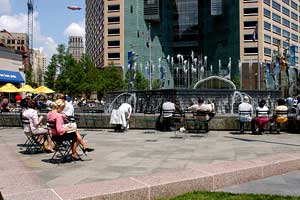
Campus Martius Park
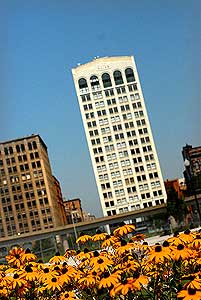
The Kales Building from Washington Boulevard
All Photographs Copyright Dave Krieger
Related Articles

Michigan Adventurer to Bike 1,000 Miles Across State to Spotlight Hidden Form of Domestic Abuse
A Michigan adventurer is biking over 1,000 miles across both peninsulas this summer to raise awareness about economic abuse: a hidden form of domestic violence that affects countless survivors across Michigan.

Detroit schools are making real gains in reading and math: 4 strategies that are working
The city’s schools are making progress faster than peer districts, but that progress could be fragile.

From brunch to wellness, here are some ways to celebrate Mother’s Day in Detroit
From brunch and dinner specials to wellness and healing-centered experiences, several Detroit businesses are offering plenty of ways to celebrate Mother’s Day.