Enter MOCAD
Detroit will have a new space to get edgy, gritty, messy and
controversial — and attract an multinational cadre of artists — when
the Museum of
Contemporary Art Detroit opens to the public this week.
Picture this: A long, one-story industrial building on a prime block
adjoining Detroit’s cultural center, its multiple medical campuses and
a university area home to over 35,000 Wayne State and College of
Creative Studies students and faculty. Across the street is the
Whitney, one of the city’s top restaurants, and just blocks away are
Union Street and the Majestic Complex, two of Detroit’s longest running
food, drink and entertainment haunts. The building was constructed in
the 1920s as a car dealership, and later reused for storage by nearby
Hutzel Hospital. But it has stood idle, and barely noticed in the
increasingly noticeable Midtown neighborhood, for years. It is
essentially a nondescript, well-preserved relic from another era
blessed by location. A building perfectly situated, in other words, to
be recast in a new role as a place to see edgy, gritty, messy,
controversial modern art.
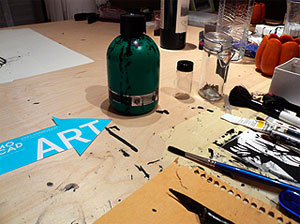 Over 10 years in the planning and
working stages, the Museum of Contemporary Art Detroit (MOCAD) is still
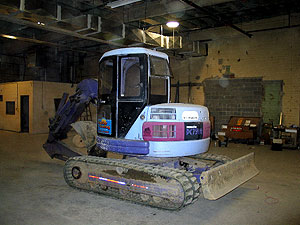
rough but ready to open to the public this week. The walls and floors
(one of the few interior decorative touches the building possesses is
Pewabic tile underfoot) have been powerwashed at least twice, says
acting curator Mitch Cope. But the grimy history of the place, its
distinct historical “Detroitness” has not been scrubbed away, despite
the recent addition of new doors, windows and lighting by architect
Andrew Zago.
Cope says that when Klaus Kertess, the curator of
MOCAD’s inaugural Meditations in an Emergency exhibition, showed up
recently at the building he urged that “nothing be touched … let the
building and the art evolve together.” Kertess, who has been active in
the art world as a dealer, writer and educator since the 1960s, had
powerful first impressions of the space. “He said ‘it was very
Detroit,’ ” Cope says, “and it that didn’t need to be something else.”
(MOCAD has a tentative four-year plan to do additional renovations that
will bring changes to the façade and to other parts of the building,
though Zago, the architect, says he wants to keep its industrial
character intact.)
Living art, contemporary issues
Kertess
was director of New York’s Bykert Gallery from the mid-1960s to the
mid-1970s, when he exhibited then-unknown American painters Brice
Marden and Chuck Close. He moved on to work at the Whitney Museum of
American Art and curated the Whitney Biennial in 1995. Kertess picked
Mark Bradford, Christopher Fachini, Barry McGee, Roxy Paine, Paul
Pfeiffer, Jon Pylypchuk, Tabaimo, Kara Walker and Nari Ward for his
first show in Detroit.
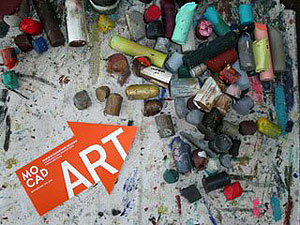 Although Kertess is more associated with
painting, he decided Meditations needed to be an exhibition largely
made up of installations. The work on display will include Paine’s
sculpture-making machine, a sound piece by musician Fachini — who has
performed with Detroit bands Godzuki, the Dirtbombs, Odu Afrobeat
Orchestra and others — and animated works by Walker and Tabaimo, an
artist from Japan. McGee, a street artist from San Francisco, was
expected to arrive early the same week of the opening and paint a mural
on the front of the building facing Woodward. Kertess and MOCAD gave
him carte blanche to do whatever he wants, Cope says.
“We don’t know what McGee’s http://www.deitch.com/artists/sub.php?artistId=1
going
to do, Klaus doesn’t know what he’s going to do,” says Cope, as a metal
door clangs and squeals as it rolls up in the background. “The idea of
a contemporary art museum is to show living art. It’s a place to deal
with contemporary issues, and to come alive in interesting ways. It’s
not meant to be an art history museum.”
What it is meant to be
is a magnet for national and international talent that shows up rarely
in Detroit. Major, innovative exhibitions have long been common in
cities like Los Angeles, San Francisco, Chicago and New York. But now
contemporary art museums appear to be flourishing in smaller cities
like Cincinnati, Columbus, Denver, St. Louis and Winston-Salem, N.C.
Some of those museums have been designed or redesigned by global
architect stars like David Adjaye (Denver), Peter Eisenman (Wexner
Center in Columbus) and, most notably, Zaha Hadid, whose Contemporary
Art Center in Cincinnati has been hailed as one of the most important
American buildings of the last two decades.
Clearly, venues that exhibit modern art create buzz in the region and get attention that often extends worldwide.
10-year plan The
The
idea for a contemporary art museum in Detroit was hatched in the
mid-1990s when Marsha Miro, a longtime art critic for the Detroit Free
Press, began talking about it with gallery owner Susanne Hilberry. The
two women, respected champions of the local art scene since the Cass
Corridor scene of the 1960s and 1970s, approached the Detroit Institute
of Arts with the idea of integrating modern works into the museum’s art
historical mission.
“They studied the proposal for five
years,” Miro says. “To their credit, they took it very seriously, but
in the end decided against it.”
While those discussions were
still taking place, DIA board chairman Richard Manoogian was excited
enough by the prospect to commit Manoogian Foundation money to buying
the building on Woodward. When the DIA plans fell through, the
foundation decided to take a chance on the fledgling arts organization,
with stipulations that MOCAD begin seating a board of trustees and get
fundraising machinery in place.
“We began adding boardmembers
and raising money,” says Miro, who worked as an archivist at Cranbrook
before devoting herself to being volunteer acting director of MOCAD.
The impressive board includes prominent metro Detroit art patrons and
business titans Linda Dresner, Danialle Karmanos, Keith Pomeroy and
Julie Taubman, who hosted one of the fundraisers.
Interventions and solutions
While
Miro and Cope work on getting MOCAD’s first show off to a good start,
they also have their eyes set on a massive international exhibition set
for early 2007.
A multidisciplinary project of the German
Cultural Foundation, Shrinking Cities was begun in 2002 to study the
declining populations in four urban areas: Halle/Leigzig, Germany;
Manchester/Liverpool, England; Ivanovo, Russia — and Detroit. The show
opened in Berlin in 2004, has traveled to Leipzig and is currently
represented at the 10th International Architectural Biennial in Venice.
The Detroit show will be split into two phases: the first at Cranbrook
and the second at MOCAD. The opening is scheduled for Feb. 2.
 Cope
Cope
has served as curator for the Detroit piece of the exhibition, which
has included local artists Tyree Guyton, Kelly Parker, Scott Hocking,
Clinton Snider, Chris McNamara and others. Sculptural, paint, written,
graphic design, architectural, video and sound media are all expressed
in works at the show. Pop-historical references are also made to the
trailblazers in soul, funk, rock and electronic music who influenced
cultural currents in the city and around the world.
Cope says
the show is so large, with over 100 contributions by artists,
architects and academics, that it couldn’t all be crammed into the
renovated 20,000 square foot space on Woodward. Buses will operate
between the two facilities, shuttling people to and from the suburbs,
consciously linking the project with mass transportation.
“The
(suburban) phase of the show will focus on the analysis part of
Shrinking Cities while the second phase at MOCAD will deal with
interventions,” Cope says. “We wanted to frame the exhibition so that
concepts and questions will be introduced at Cranbrook and solutions
and answers found in Detroit, which is appropriate.”
The
Museum of Contemporary Art Detroit is at 4454 Woodward Ave. Meditations
in an Emergency opens this Thursday, Oct. 26. Patrons can meet and
greet the artists and curator Klaus Kertess from 6-8 p.m. Tickets are
$125 in advance and $135 at the door. The Museum Preview — $45 in
advance and $55 the night of the opening — follows at 8 p.m. The
preview hours will feature ambient music by DJ Clark Warner of
Windsor’s Minus. An after-party ($10) with Ghostly International DJs
Matthew Dear and Ryan Elliott is from 9:30 p.m. to 1 a.m. MOCAD is open
to the public on Saturday, Oct. 28. For more information go to
www.mocadetroit.org
Walter
Wasacz is a local freelance writer, photographer and DJ. He traveled to
Berlin and reviewed the Shrinking Cities exhibition for Detroit’s Metro Times.
All Photographs Copyright Walter Wasacz
Related Articles

Trail Challenge offers prizes for visiting all 13 Huron-Clinton Metroparks
Since 2023, hundreds of Metro Detroiters have participated in the Huron-Clinton Metroparks’ Trail Challenge, which incentivizes participants to visit all 13 Metroparks across five Southeastern Michigan counties.

Detroit lights up for the holidays
Christmas lights show off the beauty of the city and are guaranteed to put any non-Grinch into the holiday spirit.
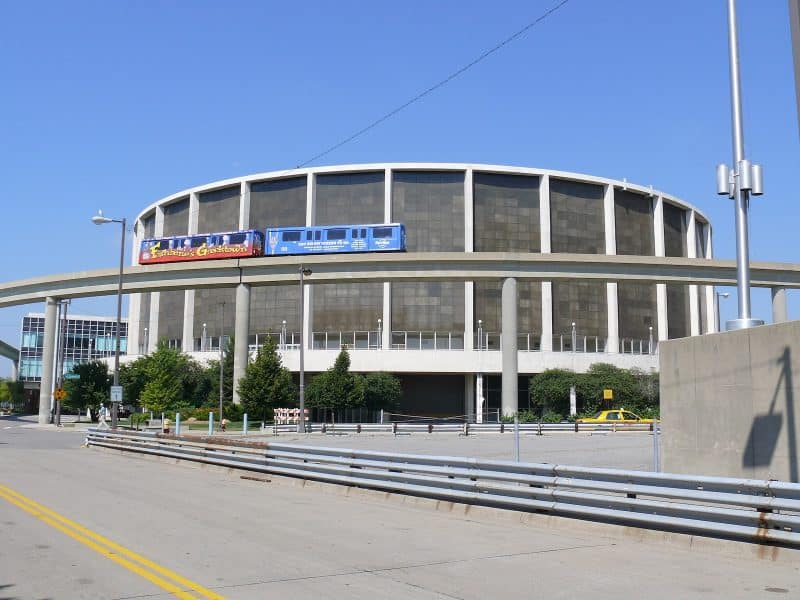
HISTORY LESSON: Public financing for pro sports venues then and now
Detroit’s first step into public sports infrastructure construction came in 1960 with the opening of Cobo Arena, the stadium component of the larger riverfront redevelopment that led to the convention hall and Hart Plaza.