Detroit By Choice
Thomas Linn’s mornings follow the flow of the Detroit River. The CEO of Miller, Canfield, Paddock and Stone
— the state’s largest law firm — generally wakes up, then sets out from
his home on the East Side in the historic Joseph Berry subdivision,
where the Manoogian Mansion is, to play at the river’s edge with the
family dog. He looks out across the river and he can see Belle Isle and
the Detroit Yacht Club.
He then follows the river’s course toward his downtown office. The view
from Miller Canfield’s lobby is stunning. The balcony that wraps around
the building at 150 W. Jefferson shows the river’s every curve as the
water winds on around this corner of the lower peninsula, connecting
suburb to city to suburb to the next city, connecting one nation to
another. As you see the steam rising from the tiny specks representing
the Fermi II plants, you can imagine the water spilling into Lake Erie
and still flowing.
From Linn’s vantage point, it’s easy to see that what happens here,
doesn’t stay here. Whether the region likes to admit or not,
everything’s all connected.
“All the stuff about city/suburb/little suburb — it’s all petty,” says
Linn, who also is part of the Downtown Detroit Partnership and is
active in river conservation through the American Heritage River Initiative.
“The region has to put aside pettiness and think larger thoughts,
because if we’re not a first-class region, the future is going to be
bleak.”
Miller Canfield is the city’s oldest firm, established in 1852. Many of
its attorneys are involved in development projects, and the firm has
represented the city and done finance work for big and small projects
alike. What’s good for Detroit is good for the region, and what’s good
for the region is good for Miller Canfield.
“To put it negatively, if Detroit doesn’t revive it’d be a terrible
place to do business, businesspeople will not stay,” he says. “But I
think it can be a dynamic economy and it should be. We should look
forward and not try to worry about the past.”
A life in Detroit
Aside from the years he spent in Ann Arbor getting educated, Linn has
spent his life within the city limits. The Cass Tech alum grew up on
the East Side, around Six Mile and Gratiot. When he and his fellow Cass
Tech-grad wife Diane Linn returned from Ann Arbor, he took a job at
Miller Canfield and they set up their home in Rosedale Park. As their
family grew (they’ve now got four children), they needed more space and
moved east to Joseph Berry.
Thomas Linn’s own love of Detroit perhaps most obvious when you talk to
his children. The apple doesn’t fall far from the tree, they say. His
two daughters live off Cass in Midtown; Emily is a purveyor of
Detroit-themed merchandise, including handmade soaps
with maps of Detroit on them. His sons are both at the University of
Michigan, where the older one, Andy, has the words “Detroit By Choice”
on his jacket and has started an online group called Detroit Born and
Raised — And Damn Proud. The group now has some 450 Detroit-born U-M
students on its roster, and has become a hotbed for discussion.
Thomas Linn gives a modest shrug when you compliment him on his kids,
but he’s obviously proud. His says its natural for young people to be
excited.
“You expect your young people to be more enthusiastic, that’s natural.
The old farts are going to be the negative ones. But I think it’s
exciting,” he says. “They’re really happy living in the Cass Corridor,
being involved in the music scene and the nightlife and hanging out at
the Bronx and going to Hamtramck.”
His children say they learned from example. “Whether it was the Detroit
Institute of Arts, the Belle Isle Zoo, or the Heidelberg Project, among
hundreds of other places, they showed me what Detroit had to offer, and
why the city was so special,” says Andy.
Thomas Linn says that’s just being part of the city where you live.
“You kind of have to put your money where your mouth is, a little bit.
If you are going to be a Detroit booster, you should be a Detroit
booster. You should do things in Detroit, live in Detroit if you can,”
he says.
Attracting talent
Being a Detroit booster, however, does not mean that Linn’s blind to the city’s challenges.
While he sees major residential developments going on in places like
Midtown, he also says that city officials have to do more to make the
city feel safe and inviting.
“Detroit has to make sure that the city is safe and clean. I think if
you do that, and make sure the welcome mat is open for all people,
you’ll get a lot of redevelopment,” he says.
Detroit’s reputation has gotten better over the past 10 years, he says,
and the Super Bowl parties surely didn’t hurt, but it still is
difficult to attract out-of-state talent. Of the firm’s 350 attorneys,
about 80 come from Wayne State’s law school and another 80 come from
U-M.
“Most people who join our firm have some connection to the region, or a
spouse or significant other are connected to the region,” he says.
“It’s a challenge for Detroit organization to attract people from
outside the region.”
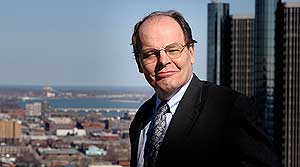
At the same time, looking out over the East Riverfront area from the
Miller Canfield balcony, Linn knows there’s a lot to be excited about
right now. He talks about the massive residential development in
neighborhoods like Midtown, and the plans that will transform the view
of the city as he looks out toward Belle Isle.
The river historically was not used for recreation, he says. It was
always seen as a commercial hub. But now, it’s got potential to
transform the city. “The riverfront, if it can be maintained as safe
and clean, will be a tremendous magnet for people, for recreation, for
residents, for all sorts of activities and all sorts of ancillary
businesses,” Linn says.
He also says the city needs to support its cultural assets, which will help attract and keep young talented people in Detroit.
“It’ll take young people who are really willing to come back — people
like my son Andy, who wants to come back and move into the Corridor and
do artistic things. He and his buddies come in on the weekends to the
Magic Stick to hear music,” Linn says. “I mean, the music alone could
carry Detroit to a higher level.
“There’s a lot of exciting things going on, and I think you just have
to keep building on what you have, and building on your natural assets.”
From Linn’s vantage point, two major assets are the river and young
creative types, and that point of view gets reinforced at home, at play
and at work.
Photos:
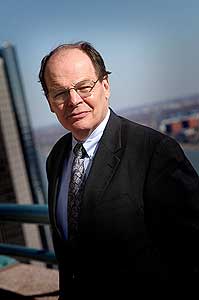
Thomas Linn on the 25th Floor Balcony of 150 West Jefferson
All Photographs Copyright Dave Krieger
Related Articles
Tracking history through stories
Long-time residents of Woodbridge tell stories of their diverse Detroit neighborhood through an oral history project meant to capture the essence of life in the area in decades past.

Detroit’s seniors are facing a winter crisis most people never see
Michigan’s Forgotten Harvest reports 291,000 seniors 60 and older are affected by food insecurity. Nearly half of them are in the Metro Detroit area. Focus: HOPE provides food boxes for seniors across a nine-county area including Wayne.

Protest watch: Three protests and a presidential response
On Friday, people gathered in Clark Park. On Saturday, they turned out to Hart Plaza, and on Tuesday, they were in front of the Motor City Casino to object to President Donald Trump’s appearance there before the Detroit Economic Club.