Downtown Detroit

Final Four weekend was a success for Detroit

Detroit's Final Four weekend was a success on many fronts.Excerpt:It was a downtown Detroit alive with electricity that was enjoyed by all.Financially, the local community benefited from an estimated $30 million to $50 million in direct economic impact during a time when businesses face challenges not seen since the Great Depression. Needy organizations benefitted from a Final Four-first food recovery program in partnership with Forgotten Harvest that donated more than 1,000 pounds of food to community service providers.Several screenings and panel discussions on the NCAA documentary "Game of Change" provided a platform for positive discourse on race relations, and more than 10,000 basketball uniforms were donated to local and statewide organizations.The Samaritan's Feet initiative donated more than 1,000 pairs of shoes, and the Boll Family YMCA in Detroit received a basketball court refurbishment from the NCAA, the Naismith Basketball Hall of Fame and the Tyler Ugolyn Foundation. More than 500 students participated in the NCAA's Middle School Madness program that provides educators with compelling learning tools centered on the elements of the Final Four. Read the entire article here.


Detroit is gaining on the national greening front

Community gardens and new bike paths and trails are helping Detroit get greener.Excerpt:But the city surprised many people last year when it moved from 43rd to 31st in a ranking of major U.S. cities judged by support for the environment. SustainLane, a national group that compiled the list, cited Detroit's decision to replace blight with a growing number of community gardens and paved pedestrian and bicycle paths. Beyond the city, Michigan has built the third-most housing units certified as green by Leadership in Energy and Environmental Design, a Washington, D.C.-based environmental building expert. Michigan has 119 such units, which meet standards such as energy efficiency, while leader California has 480. Read the entire article here.

Fancified Fort Shelby’s apartments now available

The now lease-able Fort Shelby apartments offer refined urban living in downtown Detroit.Excerpt:No detail has been overlooked in these sophisticated spaces. The kitchens boast granite countertops, Aristokraft cabinetry, GE stainless-steel appliances and hardwood floors. The bathrooms have travertine tile; double Kohler sinks in granite counters; glass-enclosed, spa-like showers; and deep, soaker tubs. Chandeliers are stainless steel in a gender-neutral style; other lighting is recessed. Carpeting is high-end Berber. Thick, horizontal, wood blinds dress the windows. The ceilings are 9 feet high. One model even has a roomy kitchen pantry. Every unit has its own washer and dryer. And the spacious, walk-in closets would make "Sex and the City's" Carrie swoon with pleasure. But it doesn't stop there. Amenities include a 24-hour doorman, concierge, cable and DirectTV, private elevator, housekeeping and dry-cleaning services. On the ground floor, there is the Finn & Porter steakhouse and sushi bar, a lounge called the Round Bar, the Bearclaw Coffee Shop and 38,000 square feet of state-of-the-art meeting space. Catering and guest suites for visiting family and friends are available. There's also in-house ATM banking and a vintage marble shoeshine stand. Read the entire article here.

Women’s culture zine creates city guide to find Motown’s ‘real beat’

Venus Zine, a women's culture site, does a city guide to Detroit and captured it quite well.Excerpt:Detroit’s culture and cadence have long been defined, respectively, by its now infamous car industry and its prodigious music legacy. Nearly every American genre shares its roots with Detroit’s musical traditions. From J Dilla and Marvin Gaye to MC5 and Derrick May, Detroit’s creative footprint spreads far and wide.A city whose reputation often precedes it, Detroit seems to be in a constant process of revitalization. In recent years, the city has poured funding into the downtown neighborhood to bring residents back within city limits. The money went, in part, to new baseball and football stadiums and three new casinos. However, these places do not house the essence of this shrinking city. It is within the neighborhoods, music venues, and markets that you’ll find the real beat of Motown.Read the entire guide here.

Wall Street Journal looks at artists migrating to economically challenged areas

Artists love cheap spaces and some of the nation's economically challenged areas offer exactly that. An influx of creatives are moving into places like Cleveland, Buffalo and Detroit looking for deals and space.Excerpt:Drawn by available spaces and cheap rents, artists are filling in some of the neighborhoods being emptied by foreclosures. City officials and community groups seeking ways to stop the rash of vacancies are offering them incentives to move in, from low rents and mortgages to creative control over renovation projects. "Artists have become the occupiers of last resort," said Robert McNulty, president of Partners for Livable Communities, a Washington-based nonprofit organization. "The worse things get, the more creative you have to become." Artists and architects are buying foreclosed homes in Detroit for as little as $100. In St. Louis, artists are moving into vacant retail spaces in a shopping mall, turning stores that stood empty for more than a year into studios and event spaces for rents of $100 a month. Artspace Projects Inc., a national nonprofit development corporation, plans to create 35 live/work spaces for artists on vacant property in Hamilton, Ohio, after converting an empty car factory and an adjacent lot in Buffalo, N.Y., into 60 artists' lofts last year.Read the entire article here.

Walkable City: Get On Your Feet, Detroit

If there's a cocktail to make true walkability, Detroit is low on some ingredients. But new projects and initiatives directed at transit, streetscaping and nonmotorized pathways are aimed at getting more people on their feet in the city.

North Carolina public radio program picks up on Detroit’s Cheers currency

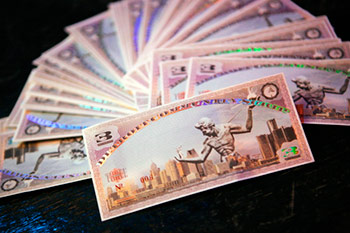
Park Bar owner Jerry Belanger and the Detroit currency, "Cheers," is picked up by a North Carolina public radio program.Excerpt:Jerry Belanger has a love for downtown Detroit. Where others may see vacant buildings and shattered windows, Jerry sees a city with soul. He's committed to revitalizing the downtown area, an effort that started with renovating an abandoned building and opening his own bar. Jerry's latest project to stimulate local spending -- and local morale -- was to create a Detroit currency called "Cheers." Jerry talks to Dick about his perspective of Detroit’s true character and what makes it so different from other struggling cities in the US.See the entire post here.Read the Model D story here.

Detroit’s transforming, but to what? NPR’s series on Retooling Detroit

Detroit needs to change and the economy is forcing it to change. NPR produces a series delving into what the city is doing and what it should do to retool itself for the future.Here are a few pieces from the series worth checking out:Commentary about the writer's love of the Brown Bombers fist and the city of Detroit here.Architects and rehabbers capitalizing on the Detroit market here.Venture capitalists and entrepreneurs sticking in Detroit here.Read the entire series here.

U of M program puts students in Detroit for a semester

University program brings students to the city to discover Detroit for a semester.Excerpt:People in coffee shops and restaurants will treat you like royalty — they will start to remember your name and your favorite items as you become a regular, as I have at Avalon International Breads. I’m Carolina, sweet cream butter scone and large "meaning of life" coffee blend. Strangers on the streets will say good morning, hello or start a conversation with you, and they will open the doors for you as you pass. In the eight years that I've been in the United States, I’ve never encountered people friendlier than those in Detroit. I’ve had some very interesting conversations with strangers in this city — people sitting next to me at Avalon while I devour my sweet cream butter scone or people sitting at the bar at Cass Cafe ordering the same local beer I’ve grown to love (Ghettoblaster, on draft). And it doesn’t take long to learn that Detroit is a city of communities. As the city tries to recover, communities and personal relationships thrive. Population loss to the suburbs and to other states is no secret here, and as a result, there are too many empty lots and less than a million people living in a city designed for two times that many. But on the bright side, those who live here know and help each other, because most of them cannot rely on anyone but themselves and the people around them.Read the entire article here.

3 Cheers for Detroit’s Local Currency

Detroit Cheers is a new local currency -- the city version of exchanging grain for flour or darned socks for a loaf of bread. Only it's more like beer for pizza, or housewares for a bike tune up.

Our Partners

The Kresge Foundation logo
Ford Foundaiton

Common Ground Is Brewing

Support local stories and receive our signature roast straight to your door when you join at the Standard level (or above).

Drink Better, Read Local

Close the CTA

Don't miss out!

Everything Detroit, in your inbox every week.

Close the CTA

Already a subscriber? Enter your email to hide this popup in the future.