
Leopold’s book shop to open in Park Shelton this summer
Greg Lenhoff, a native Metro Detroiter who recently returned after stints in Chicago and New York City, is opening a book shop, Leopold’s, in The Park Shelton building on Woodward […]
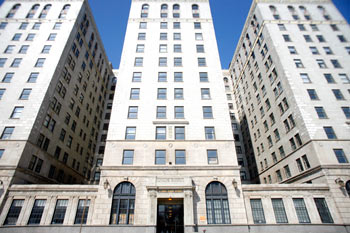
Greg Lenhoff, a native Metro Detroiter who recently returned after stints in Chicago and New York City, is opening a book shop, Leopold’s, in The Park Shelton building on Woodward […]

Will Detroit get back to its agrarian roots? It's time to explore the idea, see what we come up with.Excerpt:In its early years, under the French, Detroit was, in fact a collection of “ribbon farms,” along the riverfront, only 2-4 acres wide but running back as deep as 80 acres. This layout was practical for the 18th Century in the New World, because it gave residents neighbors within walking distance plus access to water and to the river, which was at the time the major avenue for transportation.It wouldn’t work today, of course, because Cobo Hall and downtown and other things are in the way. But with Mayor Dave Bing exploring the idea of clearing sparsely populated stretches of the city and consolidating residential areas, maybe it’s time to start thinking about what kinds of farms would work best in a new, agrarian Motor City.(Oops, that name might have to go. Maybe Detroit can become "Crop City.")Read the entire article here.
It's not 1940 but that's no matter. It hasn't stopped Detroit's cigarette girl, Gwen Joy, from making a living as if it were 1940.Excerpt:If you've been hitting the night spots in Detroit or Hamtramck, you may have seen her: a tall, willowy, mini-skirted figure striding on 4-inch heels, balancing an over-stuffed tray hanging from a strap around her neck. She's Gwen Joy, Detroit's own version of a classic 1940s cigarette girl. You may not hear her sing out, "Call for Phillip Morris," or coo, "Cigars, cigarettes, Tiparillos," like her counterpart in the 1964 TV commercial, but you will see her kitschy tray full of gum, candies and tobacco products. And she takes her wares seriously, stocking her customers' favorite sweets and keeping her cigars fresh in a humidor between sales forays. Read the entire article here.
Detroit's light rail system is inching closer and closer. The M-1 rail, the 3.4-mile route, reached an agreement to collaborate with the city with the hope that it will connect to the much larger rail line that is proposed to run up Woodward.Excerpt:Leaders of a $125 million light rail project said Thursday they have reached an agreement to collaborate with the city on a three-mile plan to link city riders in a local transit system.The privately funded M-1 Rail, an approximately 3.4 mile, 12-stop route from Hart Plaza to Grand Boulevard, would be the "first phase" of a Detroit Department of Transportation's proposed $371 million project. That plan, the Detroit Transit Options for Growth, calls for a light rail to extend from Grand to Eight Mile, said Matthew Cullen, M-1 project president and CEO."We were always going to make sure we were compatible," he said of the transit plans. "We're totally motivated to be linked up with them. It is really an important step in having a real regional rapid transit system." Read the entire article here.Read see a rendering of the rail system and read the Freep article here.Another article about light rail from Crain's Detroit Business here.
Is a second bridge to Canada necessary? Some Southwest Detroiters and organizations believe it will do more harm than good.Excerpt:While government officials have worked to promote and fast-track the DRIC bridge, misleading area residents along the way, they have ignored studies that show the project is not needed and disregarded our primary concern that this project, if built, will destroy the Southwest Detroit neighborhood of Delray.Throughout the DRIC planning process, government officials deliberately failed to seriously consider alternative locations for landing the DRIC. Alternative locations upstream were quickly dismissed once wealthy, politically active residents organized against the development in their community. Lacking the same political clout, the largely minority, low-income community of Delray is now slated for demolition.Specifically, the DRIC will force the destruction of over 250 homes, five churches and several community parks and historic properties. The area’s already-struggling economic base will shrink with the relocation of 43 businesses and hundreds of jobs. And the air quality will deteriorate, which is bad news for those in the shadow of the proposed DRIC bridge, including the students and staff at Southwest High School.Read the entire article here.
The web site couchsurfing.com can help connect Detroit to the rest of the world and give visitors an "in" to the city.Excerpt:The 24-year-old resident of the Corktown neighborhood shares her passion for the Motor City with visitors from around the globe whom she meets through couchsurfing.com.Doerr, who works as grants and contracts manager for the Wayne-Metropolitan Community Action Agency, loves to play tour guide for the guests she meets through the social network."A city like Detroit has so much to offer, but it's not user-friendly. ... You've got to have an in. Couch surfing is that in," she said.Couch surfing connects people who need a place to stay with those who can offer lodging at a great price -- free. But the mission of the site and its more than 1.1 million users is to create connections, build friendships and generally make the world a better place -- one couch at a time.Doerr, along with dozens of others, will do just that this weekend as part of the Detroit Couch Crash 2009, a series of events organized by the local couch-surfing community to showcase Detroit.Read the entire article here.
Iowa's Grinnell College, in partnership with Lawrence Tech University, will spend 10 weeks in Detroit studying how the city is reinventing itself.Excerpt:Beginning Sunday, two students from Grinnell College in Iowa will spend 10 weeks in Detroit this summer, learning how the region is responding to the challenges of the economic crash. These two women could have done summer internships elsewhere, so what is so appealing about Detroit? This is an opportunity for them to see, first hand, how Detroit reinvents itself, now that it is going through what economist Joseph Schumpeter called “creative destruction,” in which innovative people in business, government and the social sectors struggle to replace institutions that have failed....In his commencement address at Grinnell last week, New York Times correspondent and author Thomas Friedman asserted that the baby boom generation had made such a mess of the economy that the current generation of students must become known as the “Re-generation,” a role that fits perfectly with the innovative goals of the Detroit Social Innovation Project. Friedman asserted that no other era has been filled with so little certainty but so much opportunity. His latest book, Hot, Flat, and Crowded, may be a great place to start for Detroit’s and America’s Re-generation. We hope to learn from your experience in this important effort.Read the entire article here.
Detroit, as a shrinking city, may in the coming decades transform to look more like the English countryside and not the metropolis it once was, planners are saying.Excerpt:The idea may sound improbable, but Alan Mallach, a New Jersey-based planner who led the visiting team, said Detroit is evolving in that direction anyway, with large chunks of the city now largely abandoned."In a way, think of it as a 21st-Century version of a traditional country pattern," Mallach said. "You have high-density development on one side of the street and cows on the other, quite literally."The team's recommendations, contained in a draft report by a committee of the American Institute of Architects, are the latest in a flurry of ideas for dealing with Detroit's growing vacancy.Detroit's population is less than half of its 1950s peak, and an estimated 40 square miles of the 139-square-mile city are empty.The committee suggests that Detroit could recreate itself as a 21st-Century version of the English countryside."Isn't that basically what's happening? Even without any plans or strategies?" Mallach asked.Read the entire article here.
Will this be the plan to save MCS? Preservationists hope.Excerpt:“With more than 500,000 square feet of space on nearly 14 acres in proximity to critical state, regional and international infrastructure facilities, the Central Depot property has great potential to house a complimentary set of homeland security, intermodal transportation and economic development-related functions,” write the five state senators. “The property is ideally located in an area of unique intermodal convergence that includes the Ambassador Bridge, the Detroit-Windsor Tunnel, connections to three interstate highways, the Detroit-Wayne County Port and several freight lines.” (More pics after the jump.)...The timing of the senators’ plea, though, is interesting. Just last week, the Michigan Messenger reported that the Canadian Pacific Railroad is seeking $400 million to build a new freight rail tunnel under the Detroit River and likely emerging in the middle of Michigan Central’s rail yard. While building the tunnel would not necessarily save the structure, the proposal does seem to buttress the case made by preservationists that the complex still has economic value and is worth rehabilitating.Read the entire article here.
Who's the big winner this week? There's been a lot of Detroit tweets in the last seven days. Actually, there are a lot of Detroit tweets every day. Most of the tweets had to do with how the Red Wings suck or how the Red Wings were gonna destroy the Penguins. Sports tend to be a hot topic here in the Motor City -- not really a surprise though.A lot of talk about GM and the auto industry, as well.Of course none of that jazz made it to the final list. No offense Mike Illitch, Sidney Crosby, and those at GM. It just wasn't doing it for me this week.So, without further ado:Here's a trio from our friends at Inside Detroit. They were in attendance at the Detroit Regional Chamber Mackinac Conference last week and tweeted these few gems.@InsideDetroit: Did you know that Detroit has the 2nd largest theater district in the country! #mpc09No, I didn't know. @InsideDetroit: #mpc09: Detroit Zoo as a great model of regional collaboration. We do have big wins.It shouldn't be us against them, urban vs. suburban. The city needs the 'burbs and vice versa. Sometimes both sides forget that.Last but not least from Inside Detroit:@InsideDetroit: #mpc09 If we show people what Detroit has to offer people and that there are tons of us that love it here..others will love it too!It's true. A tweet not from the conference:@Michellellehcim: I'm mad that the Detroit Festival of the Arts is not happening this year... the year I'm actually living down here for the summer. figures!I think we're all a little upset about that one.And the winner is...Sycloneman: 2 hot dogs and a redpop - $5, conversation with homeless person - $1, lunch along the Detroit River, priceless!Not only is this tweet true (lunch on the Riverfront is pretty amazing) and funny, but five bucks for two hot dogs and red pop (we're assuming that it's Faygo)? Well, it's also frugal.
Our Partners




Common Ground Is Brewing
Support local stories and receive our signature roast straight to your door when you join at the Standard level (or above).
Drink Better, Read Local
