HISTORY LESSON: The Glass House: Remembering Detroit’s forgotten modernist masterpiece
When Ford Motor Company left Dearborn, it closed the book on one of the Midwest’s greatest modern landmarks — a shimmering symbol of Detroit’s mid-century confidence.
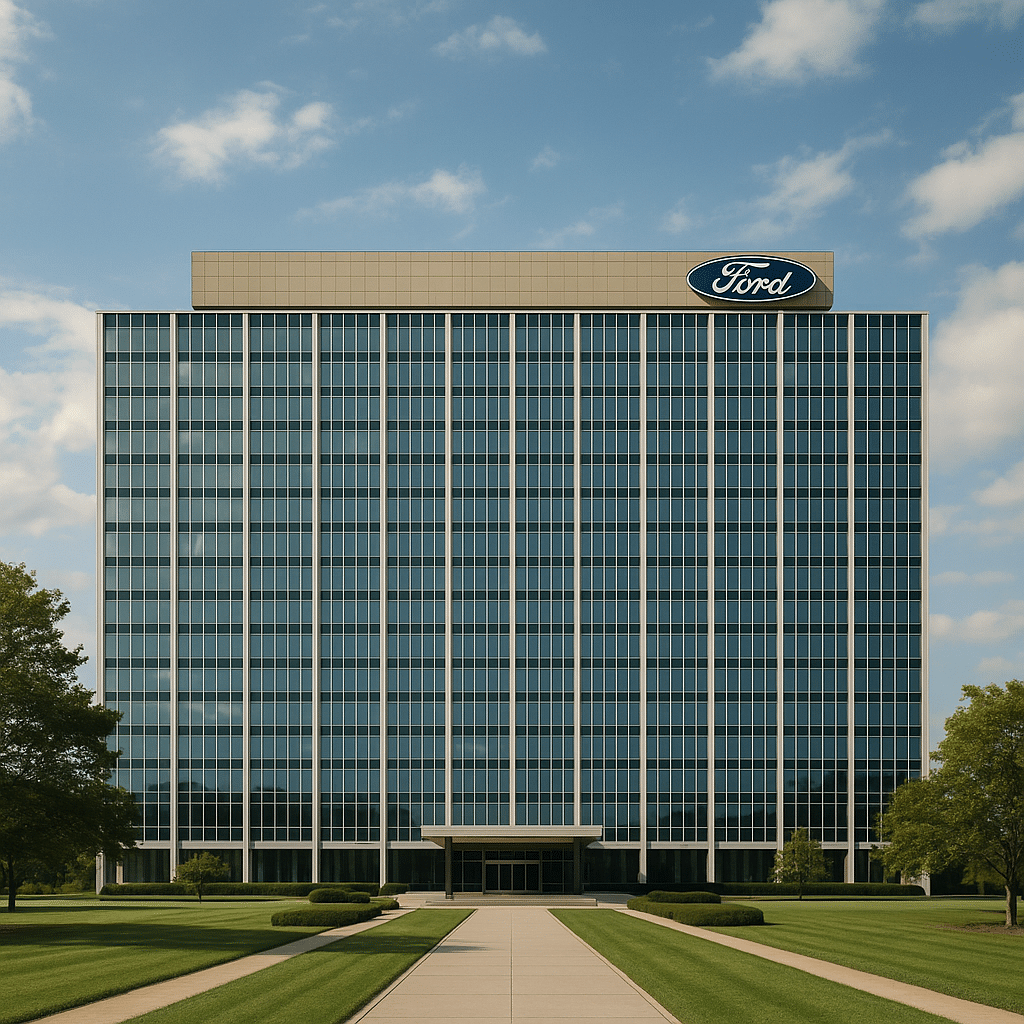
When Ford Motor Company announced it was leaving its longtime headquarters in Dearborn, it marked the quiet end of an era for the automaker and the quiet abandonment of one of the Midwest’s great midcentury modern landmarks: the Glass House. Completed in 1956 by Skidmore, Owings & Merrill, the tower was designed to look light, effortless, and unshakably confident. It reflected a company and a region that had settled comfortably into its place at the top of American life.
When the Glass House opened, it represented a shift in identity. The Ford of tinkering inventors and any color as long as it’s black had evolved into a sleek, global corporation. The glass façade became the architectural expression of Ford’s new self-image: modern, transparent, and untouchable. Its defining symbol was no longer the assembly line but the office building itself. And it was part of a broader moment when metro Detroit was shaping the modern world in ways that reached far beyond the auto industry.
In the popular imagination, Detroit of the 1950s and 1960s is seen as a city on the way down. History tends to treat this period as the beginning of industrial America’s decline. But at the time, Detroit was still in command, leading in cars, culture, and design. Berry Gordy was manufacturing hits at Motown. The MC5 was inventing punk rock. The American automobile was becoming a work of art. And the second generation of Detroit’s industrial-age architects was reshaping the region’s landscape for a new era.
Across metro Detroit, General Motors unveiled its Tech Center in Warren, a sprawling Eero Saarinen–designed campus of glass and steel that looked like science fiction come to life. Minoru Yamasaki, working from his Oakland County studio, was experimenting with form and light with his skyscraper, One Woodward Avenue, and his various works at Wayne State University. Cranbrook was exporting Detroit’s design sensibility to the world, training the next generation of architects and artists who brought modernism into everyday life. And Mies van der Rohe’s compositions of glass and steel brought International Style modernism into the heart of Detroit’s postwar skyline.
Yet we rarely speak of this era with the same affection reserved for the 1920s. The Guardian, the Fisher, and the Penobscot remain shorthand for Detroit’s rise. But the glass and steel of the midcentury years tell a different story. A story of stability and continuity.
The Glass House deserves to be understood in that context: not just as an automaker’s suburban retreat, but as a monument to Detroit’s cultural maturity. Its design belongs to the same lineage as Yamasaki’s towers, Saarinen’s Tech Center, Cranbrook’s design legacy, Mies’s townhomes, and Motown’s creative revolution. If the 1920s gave us the architecture of a booming ascent, the midcentury years cemented Detroit as a cultural capital. Ignoring that legacy means erasing the decades when Detroit not only built the future but lived in it.
Related Articles

3+13 Ways to Celebrate 313 Day in Detroit
March 13th — known locally as 313 Day — is Detroit’s unofficial holiday celebrating the city’s area code, culture, and community pride.

Travel + Leisure Names Detroit, “Most Underrated City” in Midwest. Here are 5 Gems We Think Were Missed
Detroit’s renaissance is happening in every corner of the city, often in places that fly just a little under the radar. At Model D, we’ve had the chance to cover many of those emerging spaces, projects, and entrepreneurs shaping Detroit’s future. Here are five Detroit gems we think deserve a spot on any “underrated Detroit” list.
Detroit was once home to 18 Black-led hospitals – here’s how to understand their rise and fall
Detroit had approximately 18 Black-owned or Black-operated hospitals during the 1940s and ’1950s. Their decline followed structural and policy shifts. Hospital desegregation after World War II opened previously white-only hospitals to Black physicians and patients.