Initiatives seek to connect Detroit parks via trails and greenways
Multiple efforts across the Metro Detroit area are creating non-motorized paths connecting the region’s many parks.
This story is part of a series exploring how parks serve as engines of exploration, education, play, and equity. It is made possible with support from Huron-Clinton Metroparks and the City of Detroit.
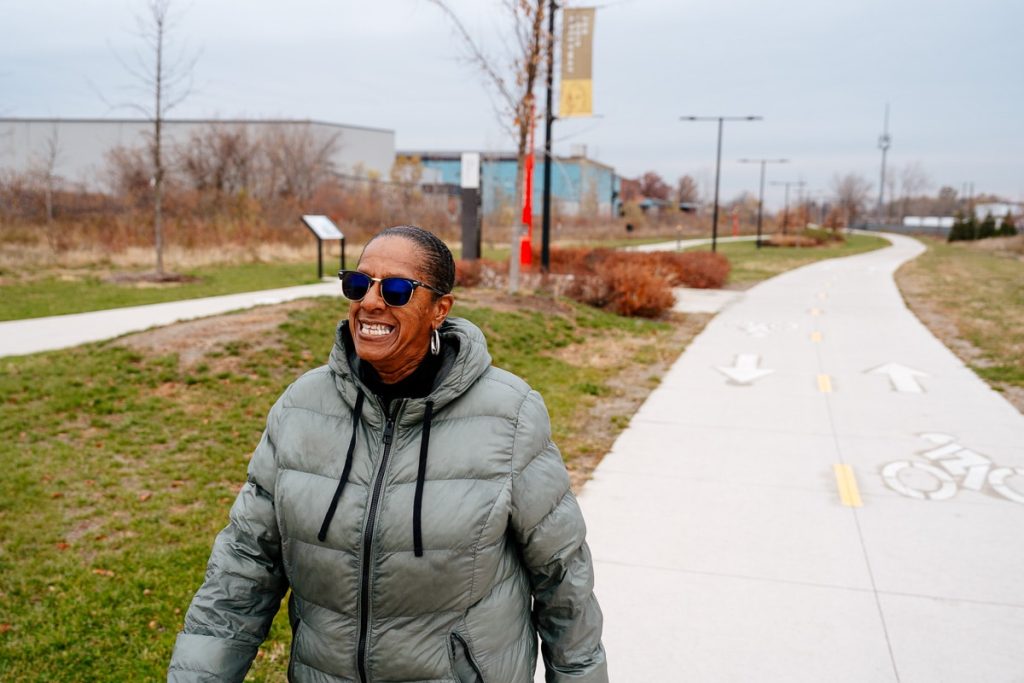
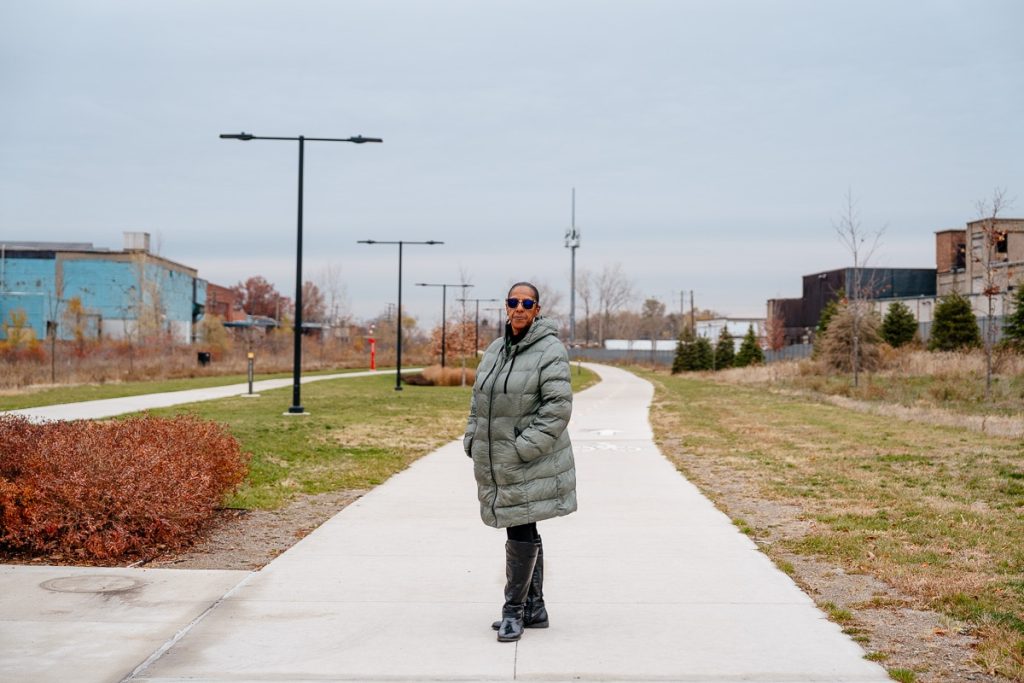
Sheri Burton has lived in the same house in Detroit’s Midwest Tireman neighborhood since 1967. Recalling the days when there was a “bustling” retail strip on Grand River in her neighborhood, she says Midwest Tireman is now what she calls a “delayed-service,” rather than underserviced, community. That’s why Burton and her fellow members of the Greenway Heritage Conservancy lobbied the city of Detroit to begin construction of the 27.5-mile Joe Louis Greenway in their neighborhood. The first stretch of the greenway opened in Midwest Tireman in 2022, followed by the greenway’s Warren Trailhead in 2023.
Burton says the greenway has been “highly populated” by users. She says it’s helped connect users of her small neighborhood park, Laker Park, to the Warren Trailhead, and it will eventually do the same for many more parks and other sites across the city. She describes the trailhead’s 40-foot slide, now a popular attraction for neigbhorhood kids, as “a moonbeam … bringing down blessings on us.” Burton has high hopes for the greenway’s potential to revitalize her neighborhood, improving quality of life for residents and bringing commercial activity to the area.
“It’s a magnet,” she says. “It’s an attractant. You have people coming to the greenway, … coming up with ideas of what they would like to see. The seasoned folks like us can say what was, and then get together with what can be. It’s really nice. I’m happy.”
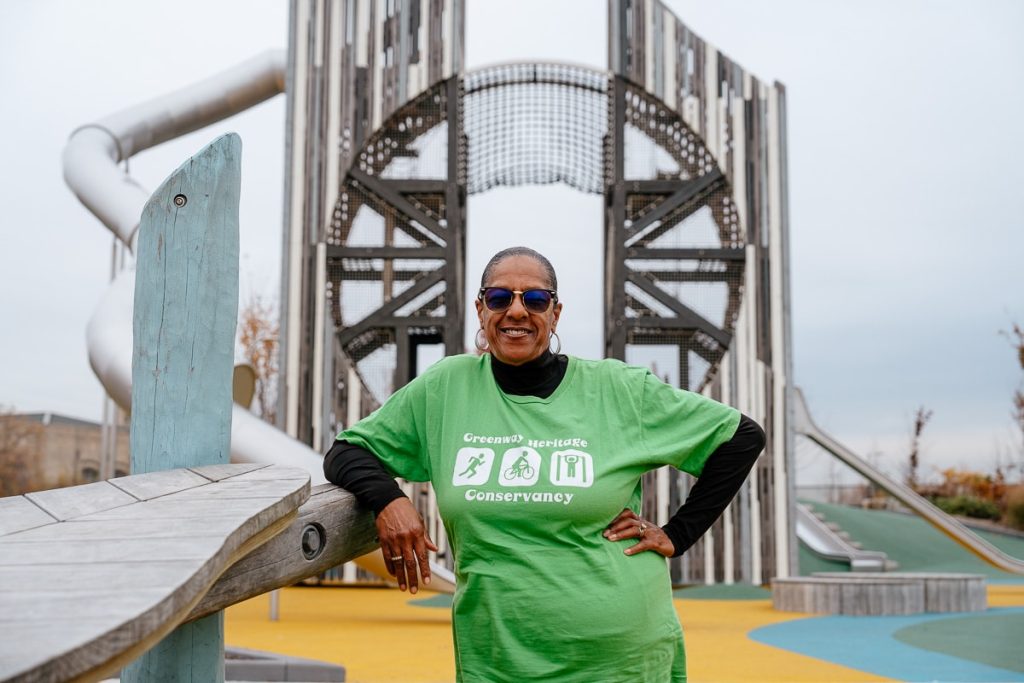
The Joe Louis Greenway is just one of multiple efforts across the Metro Detroit area to create non-motorized paths connecting the region’s many parks. Janet Briles, chief of planning and development at the Huron-Clinton Metroparks, says such connections hold a variety of benefits for residents of surrounding communities. While recreation and exercise are obvious uses for these pathways, Briles says people may also use trails to reach local businesses or even take kids to school. And as Burton’s experience testifies, connector trails can also bring quality-of-life and economic improvements to the communities they serve.
“We’ve been looking outside of our park boundaries now for a while,” Briles says. “… People have consistently been telling us – and, I think, a lot of partners in our state – [about] the desire and the need for more non-motorized trail connections.”
Connecting the Huron-Clinton Metroparks
The Metroparks’ vision of inter-park connectivity goes back to the park system’s inception in the 1930s, when the Metroparks’ founders envisioned a road that would connect what was then expected to be a four- or five-park system.
“That never happened,” Briles says. “But now here we are in the 2020s, looking at accomplishing the same thing with non-motorized trails.”
Trails connecting the 13 Metroparks, which stretch across five counties, have slowly been established over the years. For example, in the southeast of the system’s coverage area, Lower Huron, Willow, Oakwoods, and Lake Erie Metroparks are linked by a series of trails constructed throughout the ’90s, ’00s, and ’10s. In the west, Washtenaw County’s Border-to-Border Trail now connects Hudson Mills, Dexter Huron, and Delhi Metroparks.
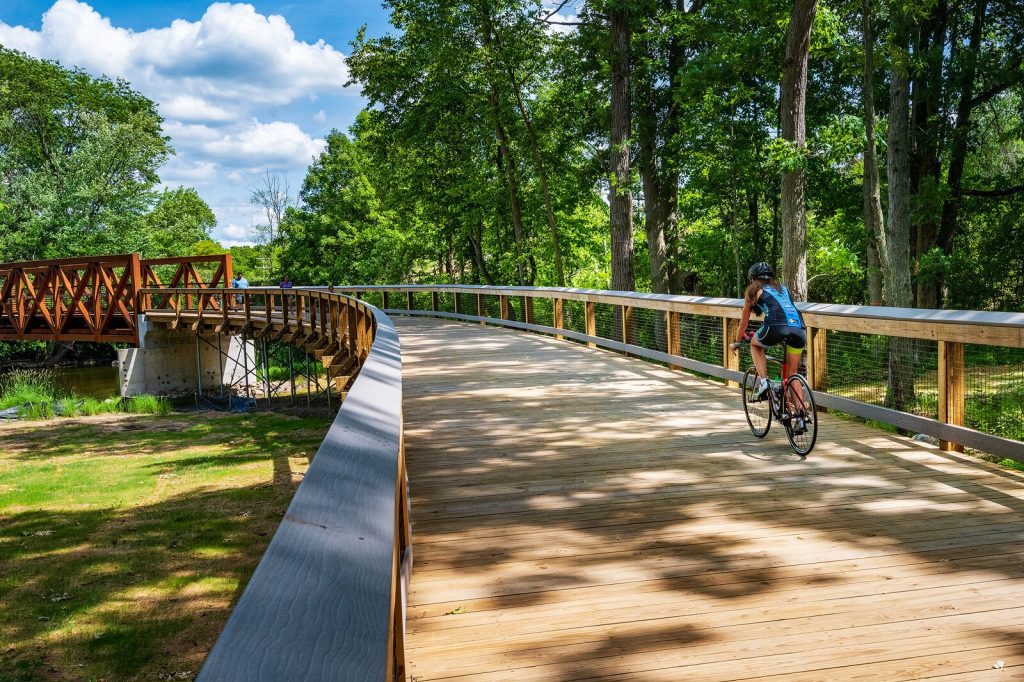
There are still major gaps that would prevent you from being able to make a complete circuit of the 13 Metroparks on non-motorized trails. But Metroparks staff are currently working on changing that. Briles says parks staff started working on closing the remaining gaps in 2023, fielding 2,200 responses to a community survey on preferred trail alignments. Staff have now identified preferred routes to build five trail segments that would finish linking the Metroparks.
Briles breaks those segments into three smaller projects and two more ambitious ones. The smaller segments would link Lower Huron Metropark to the I-275 Metro Trail, Hudson Mills Metropark to Huron Meadows Metropark, and Wolcott Mill Metropark to the Macomb Orchard Trail. The two larger projects would connect Kensington Metropark to Indian Springs Metropark, and Indian Springs Metropark to Stony Creek Metropark.
In addition to connecting the Metroparks to each other, Metroparks staff are also working on a major project to connect two of their parks to two state recreation areas. The proposed Metropark to State Park Connector would link Brighton State Recreation Area, Huron Meadows Metropark, Kensington Metropark, and Island Lake State Recreation Area. Briles says preliminary engineering on that project is complete, and the Metroparks are now applying for Transportation Alternatives Program funding for it. She says the Metroparks have strong partnerships with local municipalities and state agencies, which will be key to getting all of these connector projects done. Metroparks CEO Amy McMillan echoes that sentiment.
“The easy trail connections have been built,” McMillan says. “… It’s all about putting all the pieces of the puzzle together. And then, seriously, it’s being focused and being committed to moving forward.”
Briles says one of the most exciting parts of developing a new connector trail is ensuring that it not only links parks to each other, but also to city centers and important institutions like schools.
“The paths that are going to be most useful for people are the ones that connect different things in different places,” she says. “… It’s not just about connecting the Metroparks. It’s about meeting people where they are, connecting with their community.”
Building connectivity in the city of Detroit
That kind of connectivity – not just between parks, but between community hubs – is also key to several ambitious greenway projects in the city of Detroit. Theresa McArleton, chief parks planner for the city, describes connector trails as a key part of Detroit Parks and Recreation’s goal to ensure that all Detroiters live within a 10-minute walk of a park.
“Park connectivity is vital to the overall health of the community,” she says. “Safe and accessible park access in neighborhoods and throughout the City improve physical and mental health and provide community spaces to gather and connect.”
McArleton cites the Joe Louis Greenway, which will form a large circuit around the city and pass through Hamtramck and Highland Park, as an example of a project that will connect “neighborhoods, parks, schools, commercial corridors and more.” Idrees Mutahr, chief greenway planner for the city, agrees.
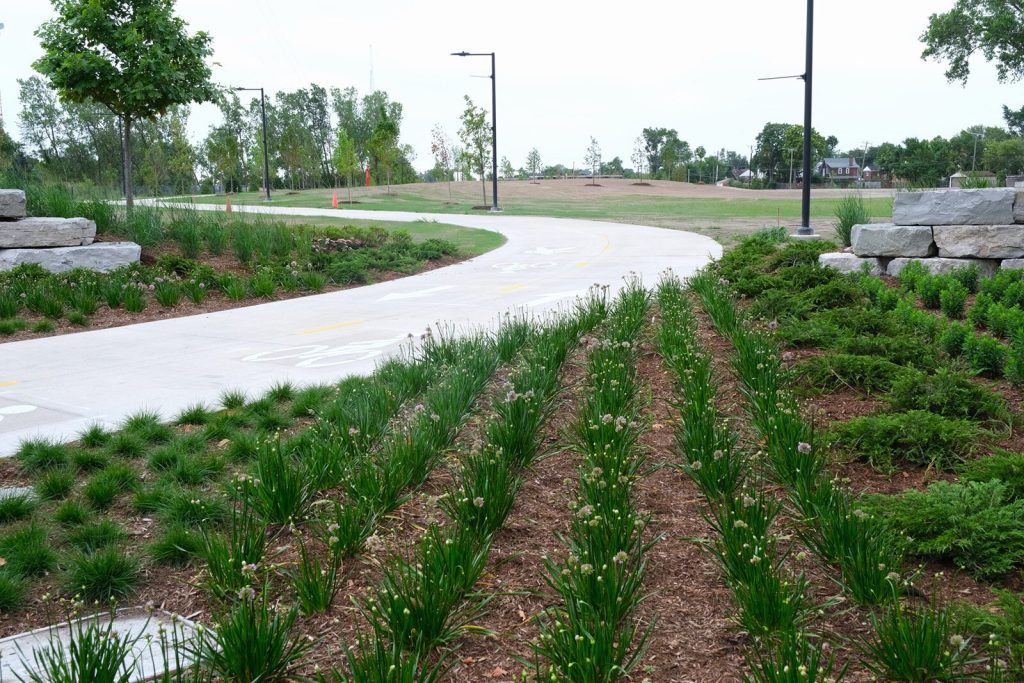
“Greenways are unique in that they serve a dual purpose as recreational green spaces and transportation corridors,” he says. “A quarter of Detroiters don’t have regular access to an automobile so expanding the city’s multi-modal transportation network helps improve the experience of Detroiters who ride a bike, walk to nearby destinations, or are connecting to transit.”
While the Joe Louis Greenway is by far the most ambitious such project in the city, it’s not Detroit’s only existing or planned greenway. Juliana Fulton, the city’s deputy chief parks planner, points out that smaller neighborhood paths “are less well known but are important for residents.” For example, the Mayor Dennis W. Archer Greenway and Southwest Greenway already help connect parks, the Detroit Riverfront, and important community sites. Fulton adds that the Rouge River Greenway has “recently gotten some planning focus” at the city. A master plan was released in 2018 for that project, which would connect Rouge Park, Eliza Howell Park, and several other parks and trails.
“It will be an amazing opportunity for residents to see the Rouge River, wildlife, and be surrounded by nature for many miles, all while still being within the City,” Fulton says.
Detroit also plays a major role in the Iron Belle Trail, a massive 2,000-mile trail crossing the state of Michigan from the western Upper Peninsula to Belle Isle.
“It is important that all Detroit residents have access to trails and recreation in the City, but trails like the Iron Belle also provide access to recreation outside of the City to Detroiters in a safe and connected way,” McArleton says. “… Connecting to a wider state system of trails and bringing awareness of the City’s parks and greenspaces is a benefit to all.”
The trails referenced in this article are just a few of the connector trails that crisscross metro Detroit. Others include the I-275 Metro Trail, Downriver Linked Greenways, and the Rouge River Gateway Trail. Burton, who describes the Joe Louis Greenway as a “win-win-win situation” for her neighborhood, is excited for the further expansion of the greenway and other connector trails.
“It’s just a good hope for the future,” she says.
Related Articles
Returning citizens face extra hurdles in Detroit’s already challenging housing market
Formerly incarcerated people face numerous challenges in finding housing, often leading them to become homeless or recidivate.
CDFIs investments in childcare allows daycares like Detroit’s Lil Love Bugs to further invest in children’s futures
Childcare is not a family issue, but a workforce issue. Members of the MI CDFI Coalition showcase how investing in quality, affordable childcare and early childhood education positively impacts the entire community.

Partner Partner Content Don’t Let Fraud and Scams Ground Your Summer Vacation
Planning a summer getaway? Before you book, learn how to spot common travel scams and protect your money so your vacation stays stress-free.