Pragmatic agent of change, Paul Hillegonds
As a state legislator, Paul Hillegonds gained a reputation for seeking old-fashioned compromise among his peers. Now he's doing the same in Detroit, working with the ACLU of Michigan on racial equity issues. Profile by Dennis Archambault.
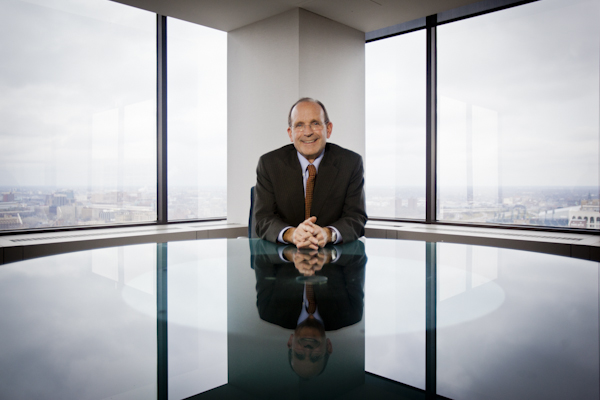

When former speaker of the Michigan House of Representatives Paul Hillegonds left his conservative West Michigan district to become president of Detroit Renaissance in 1997, he had some explaining to do to friends and colleagues. Since then, he has supported affirmative action in university admissions, promoted diversity in corporate and civic life, and has led DTE Energy‘s work with the ACLU of Michigan on racial justice issues. Hillegonds co-signed an amicus brief on race conscious admissions to universities and also contributed to the ACLU report, “Reclaiming Michigan’s Throwaway Kids: Students Trapped in the School-to-Prison Pipeline.”
There was also family value in the relocation to diverse Detroit, he reasoned. Coming from the mostly white community of Holland, Hillegonds wrote in the Detroit News, “White males like my young son…need to grow up experiencing and appreciating diversity in today’s global marketplace.”
Hillegonds spent nine years as president of Detroit Renaissance and has been senior vice president of Community Affairs for DTE Energy since 2005. He has served on the boards of directors for New Detroit, the Michigan Roundtable for Diversity and Inclusion, the Cultural Alliance of Southeast Michigan, and the Nature Conservancy in Michigan. He received the Detroit Free Press 2011 Shining Light Regional Cooperation Award.
Hillegonds believes that diversity is critical to dismantling barriers that have undermined the competitiveness of Southeast Michigan, compared with other diverse metropolitan regions in the country.
This is hardly a position you would expect a conservative Republican to take. But the former state representative’s perspective on social issues has become increasing moderate. “I have supported issues that are not conventional issues for Republicans,” Hillegonds told the Detroit Free Press last year. “I remain a Republican — a Republican whose perspective has evolved as I’ve understood the challenges we face in Detroit, the role of race, the gap or disparity in income and the effect that has, and the belief that government can’t solve all those problems but has a role in addressing them.”
Hillegonds’ exposure to race relations began in his undergraduate years at the University of Michigan at the time of the 1967 Detroit riot and Black Action Movement which addressed minority faculty and student issues.
“Race (was) always front and center for me in undergraduate school. Through that education and the political activity on campus, I came to understand more — not that race and racism are about personal attitude and personal relationships, but are about institutional barriers. Where you are born — inner city of Detroit versus the suburbs — really does make a difference in terms of your future if the schools are of very different quality.” He says this applies to income potential, health, and other quality of life issues.
Hillegonds’ philosophy of affirmative action in academia carries over to business development. For example, purchasing initiatives are important to helping develop minority entrepreneurs, he says. “DTE is more focused than we were even three years ago in expanding our Michigan purchases and also our Detroit purchases, with a recognition of doing more minority-owned business purchasing. You’ve got the same thing going on with the DMC, Henry Ford, and Wayne State developing their own purchasing initiatives.” A strategy combined with the New Economy Initiative‘s efforts “could lead to a healthier mix of entrepreneurs in the city, but it’s got to be done consciously.”
Hillegonds admits that his journey toward a more progressive understanding of social issues “has been challenging.”
There’s no substitute for being part of the fabric of the city and region and experiencing it first hand,” he says. That includes the discomfort that comes from some of the programming sponsored by New Detroit and the Michigan Roundtable, “at times (feeling) very uncomfortable having assumptions challenged, having a better understanding of institutional racism, having a better understanding of how we are all part of institutional barriers in many ways, so I like to think that it has increased my sensitivity.”
Thirty years ago Hillegonds would have been surprised with his social and political evolution, that he would be connected with the ACLU and that they would say nice things about him. On the other hand, it was a progression from the start. “In some ways, it’s not a surprise when I reflect back. My dad was viewed as liberal pastor in a conservative church and always encouraged me and my brother to be open minded and ask a lot of questions,” he says. “Not to be rigid in our attitudes toward religion and politics.”
Dennis Archambault is a Detroit freelancer and a long-time contributor to Model D.
Photos by Marvin Shaouni
Related Articles

Michigan Adventurer to Bike 1,000 Miles Across State to Spotlight Hidden Form of Domestic Abuse
A Michigan adventurer is biking over 1,000 miles across both peninsulas this summer to raise awareness about economic abuse: a hidden form of domestic violence that affects countless survivors across Michigan.

Detroit schools are making real gains in reading and math: 4 strategies that are working
The city’s schools are making progress faster than peer districts, but that progress could be fragile.

From brunch to wellness, here are some ways to celebrate Mother’s Day in Detroit
From brunch and dinner specials to wellness and healing-centered experiences, several Detroit businesses are offering plenty of ways to celebrate Mother’s Day.