Bucks Start Here: Russell Industrial
From high fashion to high-tech, and from white-collar workers to, yes, worm poop collectors, the Russell Industrial Center is hatching all kinds of entrepreneurial aspirations.
Name a major U.S. city and there is a good chance Stacey Ellis set up shop there at one point or another. New York, Los Angeles, Atlanta, Chicago, those are all places Ellis has based his business. Add Detroit to that list as the latest home for his B. Black Apparel line of denim jeans. He found the best bang for his buck at the Motor City’s Russell Industrial Center.
 His 1,000 square feet of space in the old car factory, circa 1915, turned accidental business incubator costs a fraction of the price he would pay in other major cities. In Chicago space he look at cost anywhere between $15 and $25 per square foot. New York City space started at $25 per square foot without any of the amenities and conveniences Ellis found in Detroit. The Russell Industrial Center (or RIC) leases out space at a little less than $3 per square foot.
That price and everything that comes with it couldn’t make Ellis much happier than what he is today. Not only does it give him a cost-effective home for his new business but it surrounds him with creative types of all stripes.
“Entrepreneurs are born every day,” Ellis says. “They all have dreams. This place allows you to capitalize on your dreams.
And he’s far from the only one. The Russell has taken off in recent years as a home for a range of start-up businesses as big as entrepreneur’s dreams since the Boydell Development Co. (The Nikki’s Pizza folks) took it over in 2003. Then it leased out space to about 10 different small businesses and artists. Today it has grown to about 70 and another 50 are expected to sign up by the end of this year.
 Those new businesses take up anywhere between 600 and 6,000 square feet, sometimes more. Of the building’s 2.2 million square feet, 650,000 square feet is in use and another 500,000 is ready to be built into small business spaces. The spaces are leased out almost as quickly as they are built with another 20 ready to come online in less than a month.
And the small business people with big dreams keep coming. They come for the cheap rent and almost absolute freedom to do what they want. The come for not only the vibrant creative community but the creative freedom to almost literally carve out their own little niche of the American Dream.
So much so that the Russell has accidentally become one of the state’s best small business incubators, and it’s done it without government support. It just relies on organic growth and good old fashion capitalism.
“The fact that it’s organic growth means its going to be more permanent. It’s not artificial,” says Harry Veryser, director of graduate studies in economics for the University of Detroit Mercy. “It’s probably the best growth you can get.”
Two rules
When world-famous economists Steven Levitt (author of Freakonomics) visited Wayne State University, he did not speak glowingly of the traditional government-backed business incubator. Think North Carolina’s Research Triangle Park or Detroit’s TechTown.
Levitt remarked how the history books are littered with the wreckage of government’s ambitious plans and best intentions when it comes to spurring economic growth. He emphasized the stereotypical economists’ mantra that best thing for business is low cost of doing business and little interference.
“I think the people who should make the choices are the people likely to generate the profits from those choices,” Levitt said.
That decision-making power belongs to the business owners at RIC. There is no government subsidy or overt regulation. There are only two steadfast rules: Respect the building and respect the community. Just about everything else within the law is fair game.
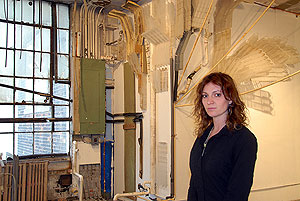 This explains why just about every sort of business has made its way into the building. There are the artists that RIC is known for, like Madeline Stillwell. The Cranbrook art student builds sculptures from rubble scavenged from bombed-out buildings that give Detroit the reputation so many wish would go away. The type of art that blends in too easily with the grimy factory windows of the dimly lit rustbelt structure.
Then there are the people you don’t expect to see there, like Leroy Jaggers. The middle-aged owner of Ultimate Photo Impressions (puts kids sports pictures on balls) turned his few hundred square feet into a sparkling, well-lit office that would rival most other suburban office spaces. Or Holly White who is using her 1,000 square feet for a worm farm to make top soil and organic fertilizer. The almost-anything-goes freedom at the RIC gives her the piece of mind to open up her shop.
“If I could find twice the space at half the cost, I’m not sure the landlord would be cool with it,” White says.
Not far away are the RIC’s white-collar workers, such as 28-year-old Andre Perkins. The co-owner of Orbis Group recently moved his Internet consulting and multimedia firm from Ypsilanti to RIC. He and his partner Pierre Greenwood turned their 1,000 square feet of loft-like white box space (they pay $550 a month) into a corporate-like space with a fast Internet connection. And Perkins calls the $500 cost to create the space a price “you can’t beat anywhere.”
“We didn’t have to ask for permission for anything,” Perkins says. “I can have my 200-gallon fish tank here and I don’t have to worry about anybody complaining. We wouldn’t move and we plan to stay here for a while. Our business will grow in the RIC.”
 The low-cost rent and freedom to not worry about getting dirty or making too much noise may seal the deal, but the creative community often attracts them at first. The RIC doesn’t have an advertising budget, so it relies on viral marketing and word of mouth.
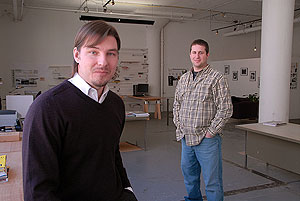
The creative environment where people skateboard down the halls (a common sight) attracts more birds of that feather to flock and do business together. It’s what enticed Roger Berent, 34, to move his architecture firm (Metropolitan Architecture Practice) to the RIC.
“It gives us an exposure to people we might not meet if we were in an office in Troy,” Berent says. “We consider ourselves designers so we appreciate being around creative people.”
Bright future
Eric Novak, the RIC’s leasing agent, considers it a melting pot for artists and small businesses. He recognizes that the place that once thrived as the home of the Murray Body Company where thousands of factory workers built bodies for the Dodge Brothers now relies on entrepreneurs for its bread and butter.
The management usually gives out month-to-month leases and is willing to work with tenants if money comes in slow. As Novak puts it, management recognizes that “if they don’t succeed we won’t succeed.”
And if they do succeed to the point where moving away makes more sense, then that’s fine, too.
“Them moving out is no big deal,” Novak says. “We don’t stop them. They’re growing. We like that. They’re welcome back.”
And there is room for the foreseeable future. There is still the 500,000 square feet of space ready to be built out and another 1.1 million square feet that is in the stereotypical Rustbelt factory shape. Think Packard Plant without people tearing it apart. Novak expects to net another 50 businesses this year, including a café. He hopes it will be fully leased within 10 years.
 It seems entirely plausible. Novak is in a constant state of motion during the workday. A nearly constant stream of tenants flow through his office, bouncing ideas of him and each other. Perspective tenants frequently blow up his cell phone inquiring about space. Novak hustles between meetings, tours and cigarette breaks in an intriguing state of almost-controlled chaos that serves as a microcosm of life in the RIC.
It’s the sort of activity that makes UofD Mercy Economist Veryser excited. He says the RIC can expect this type of growth and even nearby (Hamtramck and New Center) spin-off economic activity to service the tenants there.
“Economically, this is the best thing we can hope for,” Veryser says, adding those entrepreneurs will stay as long as the cost of doing business remains low. That makes it real while growth in government-backed business incubators is more artificial because they depend on tax and commercial space subsidies that eventually end. The RIC doesn’t have to worry about that because its business model already works, a point Veryser says is “the most beautiful thing about this.”
The low rents and two rules look to be a fixture at the RIC for the time being. Management goes with what works and those two key points are serving the RIC well as it continues to work to fill up the space.
“We just follow it as we go and go with the flow,” Novak says. “We adjust as this place reinvents itself on an almost daily basis.
Photos:
Stacy Ellis of B. Black Apparel with his Wife Modeling the Clothes
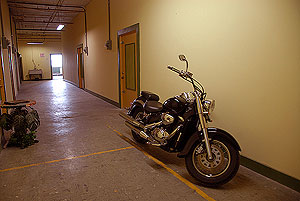
A Motorcycle Parked Outside a Studio
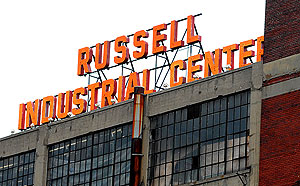
The Russell Industrial Center Sign
Madeline Stillwell, at The Detroit Industrial Project Gallery with her Installation
Metropolitan Architecture Practice’s Roger Berent and Kyle Hulewat
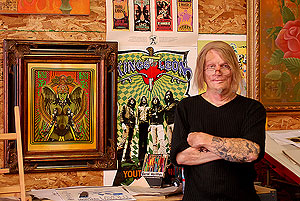
Mark Arminski
All Photographs Copyright Dave Krieger
Related Articles

Rx Kids officially launches in Detroit, marking largest expansion yet
Applications for Detroit families who want to enroll is Rx Kids are now open at RxKids.org and are also accessible through the City of Detroit’s website.

Composting project empowers Detroiters to reduce food waste, protect the environment
Food waste makes up one-quarter of landfill waste and contributes to more methane emissions than other landfill materials. The Detroit Community Composting Collective Project is out to curb food waste by training backyard composters.

Partner Partner Content Reduce Food Waste in Detroit by Composting
More than 6000 pounds of food waste have been composted. Between the overwhelming response to the call for participants and the comments from participants and even passerby at the co-op, the project has demonstrated a distinct enthusiasm for composting among city residents.