Partner Partner Content Reduce Food Waste in Detroit by Composting
More than 6000 pounds of food waste have been composted. Between the overwhelming response to the call for participants and the comments from participants and even passerby at the co-op, the project has demonstrated a distinct enthusiasm for composting among city residents.
Even the most organized among us have had this happen – you go to the farmer’s market or the grocery store, load up on beautiful fresh produce – and then find some forgotten cucumber gross and slimy at the bottom of your veggie drawer a week and a half later. But when that happens, it impacts more than just your own personal case of “the ick.” Food waste produces more methane gas than any other material in landfills as it decomposes. Methane is a significant contributor to the warming planet; and that statistic fails to address the wasted water, carbon emissions and beyond, that occur when food is wasted.
However, there are ways you can reduce the impact of wasted food on the planet. One of the simplest ways? Composting. Peels and trimmings from vegetable and fruit prep, coffee grounds, eggshells, newspapers and brown paper bags can be composted: turning food waste into nutrient-rich soil that’s referred to as, “gardener’s gold” for the healthy plants it produces. Those plants can then be composted themselves, creating a circular economy where little to nothing goes to waste.
Detroit has had no fewer than three active composting programs running this year. One is a continuation of work by a longtime food justice practitioner, another is a City of Detroit project that could be a precursor to a more widespread composting effort, and the third is a collective formed by six food justice organizations that trained a cadre of composters throughout the city.
Renee Wallace of Food Plus Detroit has been involved in composting work for more than 10 years. As she formed Food Plus and began looking at innovation in the Detroit agriculture community, she identified a need for soil building. Soil, though, is not static – it needs constant replenishment – and composting is an important way to create good quality soil that can nurture healthy food. Over the years this has taken many forms: training the community around composting in partnership with the US Composting Council, teaming up with Wayne State University to compost leftover food from campus buildings, working with Councilman Scott Benson’s Green Task Force, and setting up a demonstration system at Georgia Street Community Collective, and others. Wallace has also teamed up with Mark Covington of Georgia Street to create ReMark Composting Systems, which can design and build larger-scale composting systems that address many common concerns, such as odors and rodents. That experience convinced Wallace that what’s really needed is an integrated system of trained, committed community composters across the whole city. “We have to have an enabled policy to do things; enabled people who understand what composting is and what their role is, and enabled practice and people who know how to do it at whatever level they choose,” said Wallace.
Wallace serves as a consultant on the City of Detroit’s community compost project, which was funded by a grant from Carhartt, and also working with the city to amend its current composting ordinance. The City of Detroit project is led by the Office of Sustainability, with the Detroit Black Community Food Sovereignty Network (DBCFSN), acting as a key partner.
Last summer, the city put out a call for 100 people to participate in the community composting project; requiring participants to collect food scraps and bring them to a collection site at the Detroit People’s Food Co-Op. The feedback was overwhelming, as 580 people signed up to participate; causing a over 400 interested participants to be added to a waitlist. A MegaReecle composting machine was installled at the co-op, equipped with enzymes to quickly break down food scraps along with a rotating arm that stirs and aerates the compost mix – as compost that hasn’t been aerated enough can cause odors. ”It takes away the ‘yuck factor’, and the machine itself helps break down the volume [of scraps] by 50-75 percent,” sais Aria McElroy, a mayoral fellow with the Office of Sustainability and youth representative for the Detroit Food Policy Council.
Every Tuesday and Saturday, participants brought food scraps to be composted in the machine. Once the scraps were broken down and reduced in volume, the mix was brought to D-Town Farms for curing and use as an amendment for the farm’s soil. Both the Co-Op and D-Town are affiliated with DBCFSN.
So far, more than 6000 pounds of food waste have been composted. Between the overwhelming response to the call for participants and the comments from participants and even passerby at the co-op, the project has demonstrated a distinct enthusiasm for composting among city residents. “We definitely hear a lot of people saying ‘I have been waiting for this’, McElroy says. “Mostly people are excited to be able to do this and make it a long-standing program within the city.”
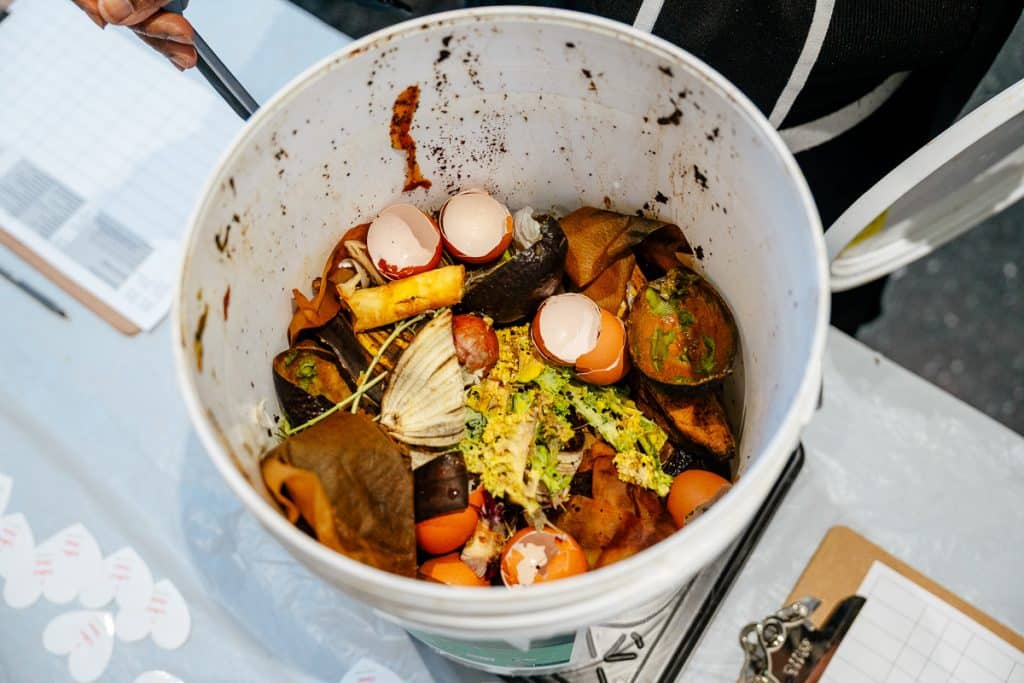
To that end, the city is revamping the open space regulations around composting, with the intent to have a decentralized compost dropoff site in each council district. The idea behind pursuing that model rather than a curbside collection is that people are more likely to commit to composting if they are actively choosing to do it.
While Wallace’s projects have largely worked with institutional and agricultural composters, and the city focused on a community model, the Detroit Community Collective Composting Project (DCCCP) addressed each of those levels as well as backyard composting. The project paired up community composters with seven farms throughout the city; at each, composters brought their food scraps to the farm and helped turn the pile to aerate it. Sanctuary Farms, which creates and sells compost from their site at the Riverbend neighborhood on the east side, taught farmers about composting on an industrial level. Nearly 100 backyard composters received a backyard compost bin as well as a kitchen pail to collect scraps, as well as three training sessions to teach participants how to create a healthy compost pile and the science behind composting and its role in soil health.
DCCCP is made up of six organizations which have long histories in food justice, environmental justice and food policy: Sanctuary Farms, Sacred Spaces, DBCFSN, DFPC, Oakland Avenue Urban Farm, and the Detroit Black Farmer Land Fund. A team of graduate students from University of Michigan’s School of Environment and Sustainability also joined the project, gathering and analyzing data from participants and co-creating a curriculum.
The project was sparked in 2024, when a team from what is now Full Circle Future, a think tank dedicated to creating a no-waste circular economy, approached Sanctuary Farms co-founder Jon Kent about supporting their work. Kent saw this as an opportunity to convene a group of similarly-oriented organizations to work on a project together, and the DCCCP was formed. “These organizations do amazing work and all have a history with urban ag and composting,” he says. Operating under a shared governance model, DCCCP is evolving into a movement hub with an advocacy focus. As the composting pilot project wraps up, the team is working with local schools to help them establish composting programs, as well as advocating for a fund that would support schools that want to begin composting statewide to be included in the state budget.
Wallace says it’s essential that people understand that compost is critical to the health of the planet and its people, and that they have a role to play. “Soil is critical to our existence, and what we do with sol impacts systems like the food system; it affects air and water, and it affects climate. It’s important people understand what we talk about when talking about diverting organics. It is waste only if you throw it away; it is a resource when you make it into soil.”
Related Articles

John Conyers III discusses his father’s legacy, his book, and his own political ambitions
Before he was an aspiring politician, John Conyers III was simply the son of Congressman John Conyers, Jr. and former Detroit City Council President Monica Conyers. Now, his sights are set on a Senate seat.
Mapping Detroit: Green Book Locations
Green Books mirrored the state of discrimination, racism, and African American rights in the nation each year. Detroit’s listings started in 1938.

3+13 Ways to Celebrate 313 Day in Detroit
March 13th — known locally as 313 Day — is Detroit’s unofficial holiday celebrating the city’s area code, culture, and community pride.