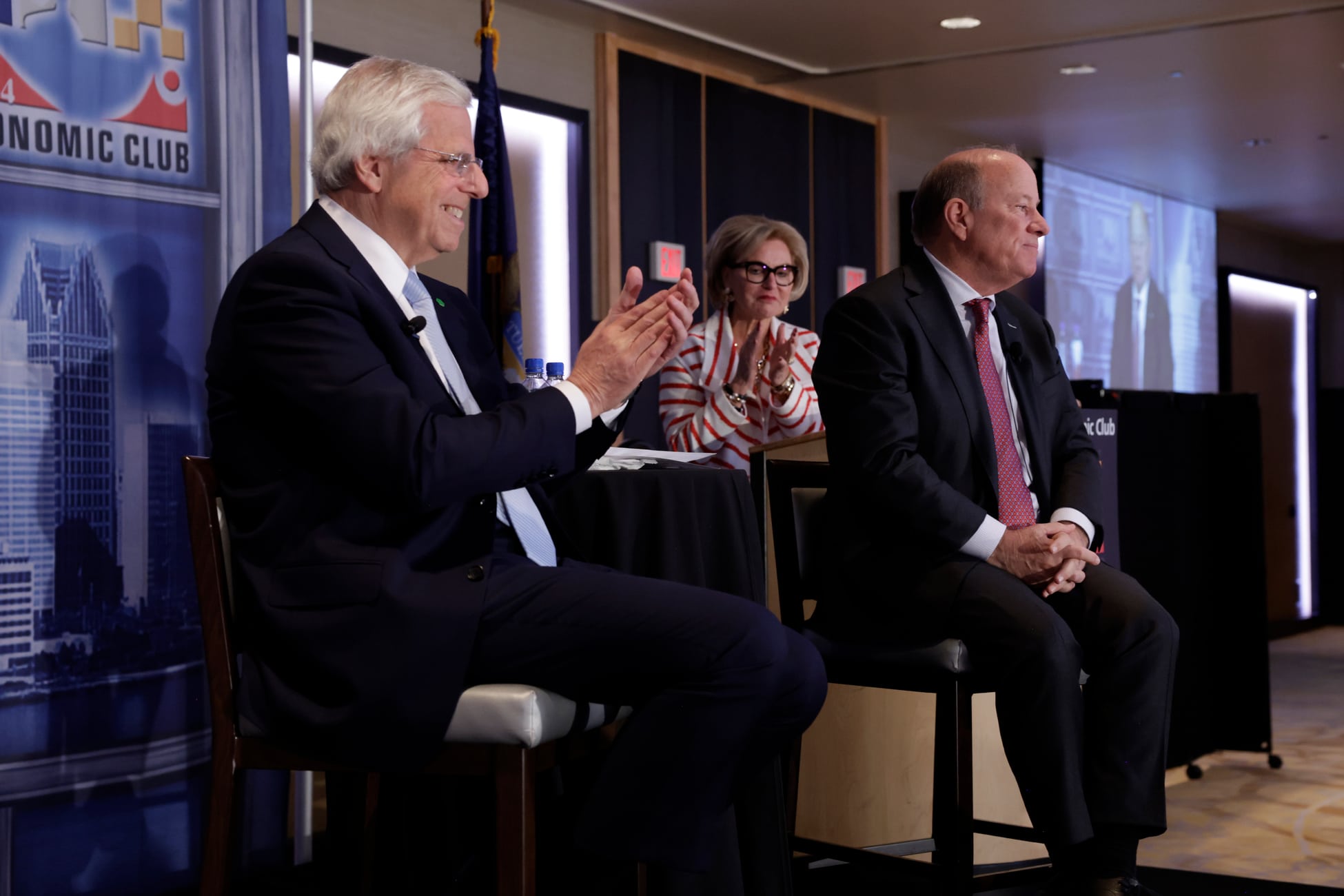
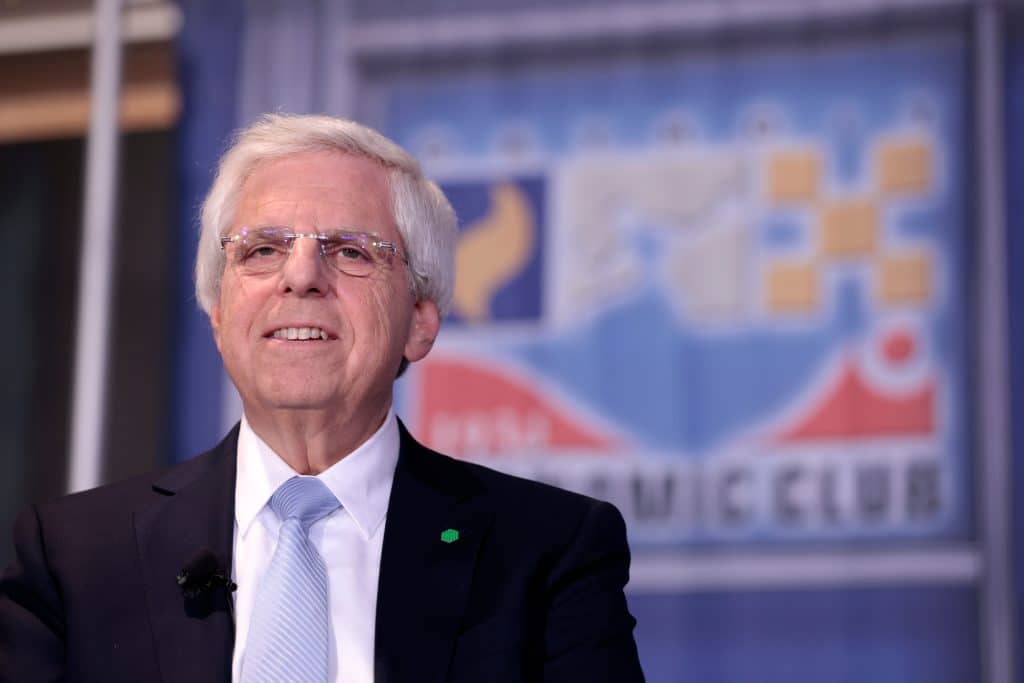
Editor’s note: We couldn’t make it to the Detroit Economic Club on Monday, but through the magic of YouTube transcription, artificial intelligence, and human editing, we offer this report. The event was covered by Detroit PBS, the viewer-supported PBS member station serving the nation’s 11th largest television market.
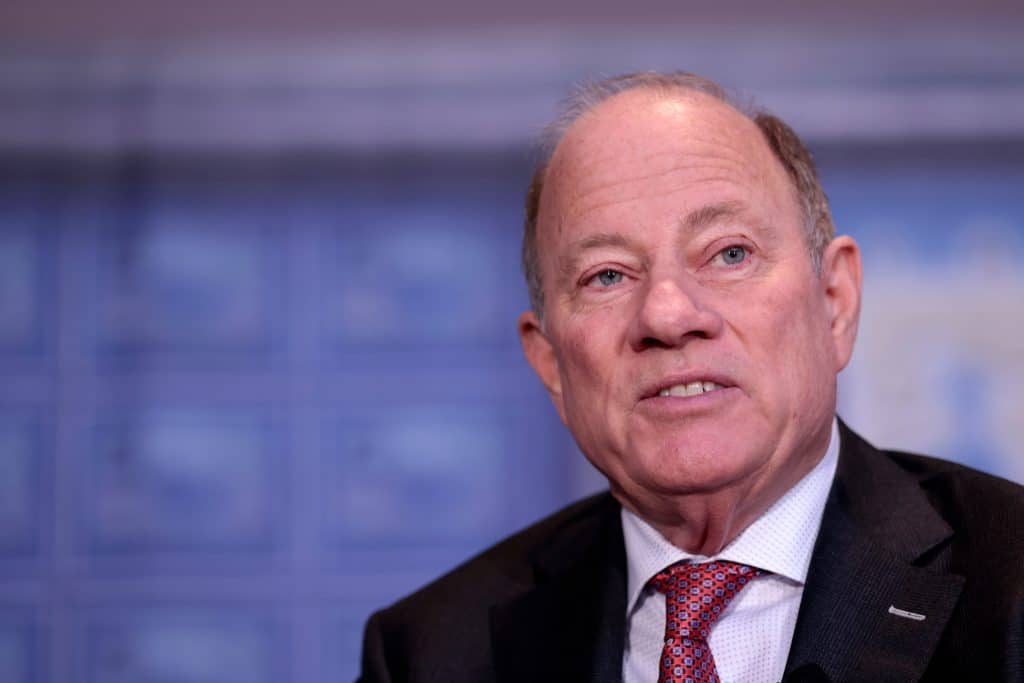
Twelve years after taking office in a city of darkened streetlights, broken ambulances, and the largest municipal bankruptcy in U.S. history, Detroit Mayor Mike Duggan stepped before the Detroit Economic Club on Monday with a very different story to tell — and a hint about his own future.
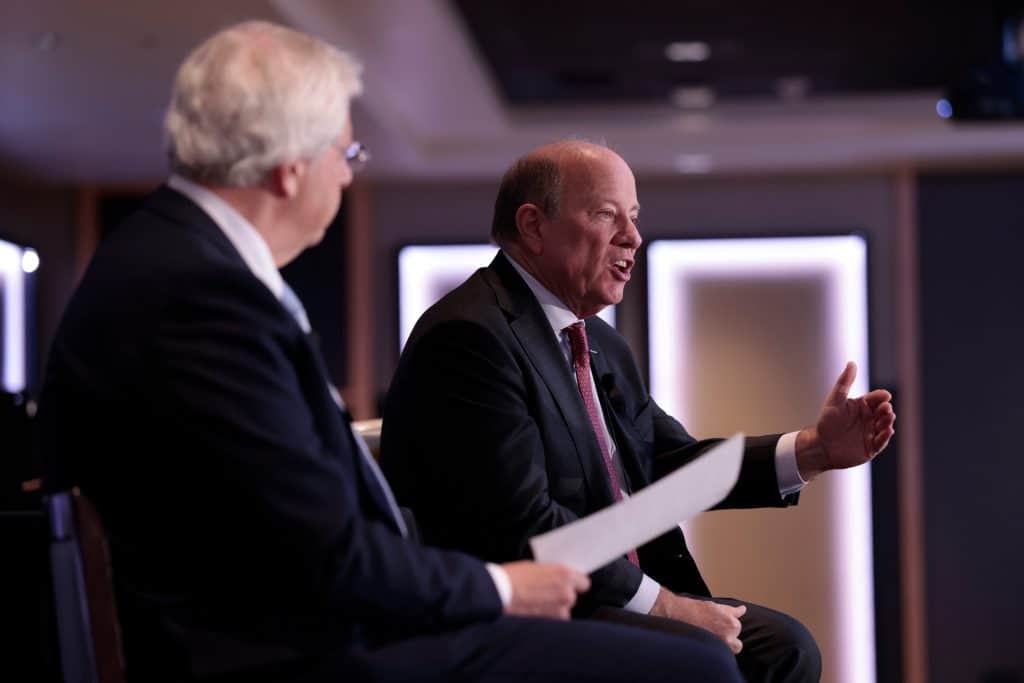
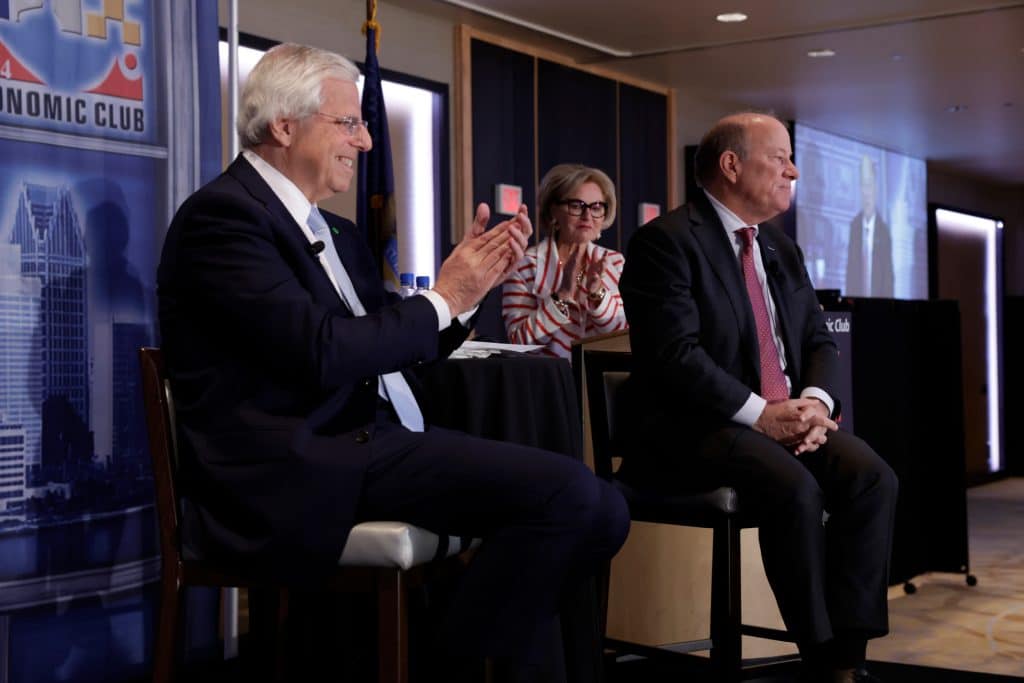
During a candid, hour-long conversation with civic leader Gary Torgow, Duggan traced Detroit’s rebound from crisis to comeback, crediting data-driven policing, massive service upgrades, neighborhood investment, and new political cooperation for what he called a “historic transformation.”
The outgoing mayor celebrated milestones such as hosting the NFL Draft and landing the Stellantis Jeep plant while warning that improving public schools remains Detroit’s biggest long-term challenge. Duggan stopped short of announcing a campaign but told the crowd he plans to “campaign hard” in 2026 if voters want a break from partisan politics.
When Duggan first walked into the mayor’s office in 2014, Detroit was still reeling from bankruptcy. Tens of thousands of abandoned homes dotted neighborhoods; 65,000 streetlights were out; EMS vehicles routinely broke down; and the city had the highest carjacking rate in the country. “Operationally nonfunctional,” is how Duggan described the Detroit he was elected to lead. But he said the turnaround began with frontline workers who “wanted to go from being embarrassed to being proud.”
He recalled meeting with city employees — mechanics, park workers, police — and setting simple expectations: cut the grass, fix the ambulances, pick up the garbage. “The power of people when they work together for a single goal is enormous,” he said. Within years, Detroit had restored every streetlight, cut EMS response times, and launched one of the most aggressive blight-removal campaigns in the country.
Public safety was a defining challenge of his early tenure. With 750 carjackings the year before he took office, Duggan realized police leadership’s training in criminal justice was not serving them. “I sat down with the police department, and I said, ‘Look, we’re going to have strategies and metrics. I’ll give you the money. I want to see your ROI.’ And these police are like, ‘ROI? What’s ROI?’ I said, ‘Look, I’ll put money behind you, but there’s got to be a return on investment, not in dollars, but in reduced violence.'”
He found that to be in the top 30 spots in the police department, they had to have a college degree — 29 had degrees in criminal justice, and one had a degree in chemistry. “I’m not sure how he got in there. But I said, ‘You guys are running a 30,000-employee, $350 million business. We don’t have HR expertise. We don’t have finance expertise. We don’t have planning expertise.” He partnered with Wayne State University to create an executive MBA program for police leadership, a move he credits with reshaping the department’s command structure. Today, carjackings have fallen by 90 percent, and homicides are at their lowest point in decades. He predicted Detroit could eventually see fewer than 100 homicides annually — a threshold that once seemed unimaginable.
Economic development was another central theme. The Jeep plant deal, which brought 5,000 Detroiters into union jobs, stands out as one of the administration’s biggest victories — and one of its most dramatic. Duggan recounted the frantic final 48 hours when negotiations stalled because a railroad company refused to sell a small but critical strip of land. After a photo of the overgrown, unused track made its way to JPMorgan Chase CEO Jamie Dimon — whose bank financed the rail company — the deal broke loose. Duggan said it was an example of how unconventional partnerships fueled Detroit’s recovery.
The same collaborative spirit defined Detroit’s high-stakes pitch for the 2024 NFL Draft. Rather than sequestering fans in a park far from downtown as cities that had hosted the previous two drafts had done, Detroit took the riskier path: closing streets, involving local businesses, and relying on the city’s camera network to monitor crowds. Two hours before the event opened, every camera went dark after construction crews accidentally cut a fiber line. AT&T technicians restored service with minutes to spare. The result — 775,000 visitors and glowing national coverage — symbolized for Duggan the Detroit that now exists: competent, confident, and ready for prime time.
Yet Duggan acknowledged unfinished work. Detroit’s much-heralded population gain — its first in 60 years — masks the reality that most new residents are singles or young families with toddlers. “Almost no families with school-aged children are moving into the city,” he warned, arguing that Michigan’s school funding system must change if Detroit is to grow sustainably.
As for what comes next, Duggan left little mystery. He criticized Lansing’s entrenched partisanship and said Michigan needs a leader focused on literacy, tech-sector growth, and keeping young people in the state. “If you’re tired of politics as usual,” he told the audience, “I’ll be campaigning really hard.”
Detroit’s Riverfront Renaissance
Few projects better illustrate Detroit’s transformation under Mayor Mike Duggan than the evolution of the city’s riverfront. Once an industrial corridor dotted with contaminated sites and abandoned buildings, the riverfront has become one of the city’s most powerful tools for attracting talent, investment, and new residents.
Duggan told the Detroit Economic Club that the riverfront was one of Detroit’s greatest untapped assets when he took office. Working with the Detroit Riverfront Conservancy, corporate partners, and philanthropic supporters, the city began piecing the waterfront back together — park by park, parcel by parcel. Riverside Park in Southwest Detroit reopened after contaminated soil was removed. Ralph Wilson Park introduced world-class design to the shoreline. On the east side, the long-vacant Uniroyal site is now slated to become a youth sports complex for volleyball, basketball, soccer, lacrosse, and flag football.
Duggan said the riverfront’s momentum is accelerating, with future redevelopment poised to reshape the Renaissance Center area into a pedestrian-friendly district reminiscent of Chicago’s Navy Pier. Ultimately, he argued, a vibrant riverfront will help drive the next phase of Detroit’s growth by retaining young talent, drawing new residents, and strengthening the city’s identity as a place of possibility.
Major milestones by the numbers
Detroit’s transformation under Mayor Mike Duggan was driven as much by operational overhauls as by marquee developments. When he took office, the city was fresh out of bankruptcy with 47,000 abandoned homes, 65,000 dark streetlights, and EMS vehicles regularly sidelined by mechanical failures. Duggan’s early focus was on restoring the basics: fixing ambulances, replacing streetlights, and empowering frontline workers to deliver the services residents had long been denied. Crime reduction became one of the administration’s most notable achievements.In 2013, Detroit experienced 750 carjackings; in 2025, that number is projected at just 76. Homicides have fallen to levels not seen in decades, a shift Duggan attributes to data-driven policing, community violence intervention, and a professionalized command staff shaped by an executive MBA program developed with Wayne State University. Economic development reshaped entire neighborhoods. The Stellantis Jeep plant, when it hired Detroit residents, added 5,000 Detroiters to the middle class, while the riverfront redevelopment — from Riverside Park to the new Ralph Wilson Park and the long-delayed Uniroyal site — became central to Detroit’s talent attraction strategy. Hosting the 2024 NFL Draft drew 775,000 visitors and solidified the city’s growing national reputation.
The full transcript can be found here.
The Detroit PBS video of the event can be seen on its YouTube channel here.
Related Articles

Jocelyn Benson followed a civil rights hero to Alabama. It shaped her path to power.
Benson’s journey to the governor’s race began with a mother from Detroit who set out for Selma in March 1965 to join the fight for voting rights.

John Conyers III discusses his father’s legacy, his book, and his own political ambitions
Before he was an aspiring politician, John Conyers III was simply the son of Congressman John Conyers, Jr. and former Detroit City Council President Monica Conyers. Now, his sights are set on a Senate seat.

Head Start Parent Conference in Detroit equips Michigan families for advocacy
One-day convening prepared families to advocate for the early childhood programs they depend on.