Detroiters lead grassroots efforts to fight food insecurity
In Detroit, neighbors and organizations are turning vacant lots, leftovers, and community fridges into lifelines in the fight against food insecurity.
This story was provided by Detroit Food Policy Council
The statistics on food insecurity in Detroit are grim. According to the Detroit Food Metrics Report, more than two-thirds of Detroiters at least occasionally can’t get enough food to meet their basic needs. And that statistic doesn’t reflect the federal government’s recent cuts to SNAP (the Supplemental Nutrition Assistance Program, formerly known as food stamps) and to aid to food banks. That means many people will soon face an even greater crisis in food access.
Of course, Detroiters are experts in making a way out of no way, and that holds true for feeding vulnerable members of our community. Alongside the traditional food pantries, soup kitchens, and food boxes, networks of mutual aid have sprung up that aim to rethink the traditional charity model.
Mutual aid is characterized by the concept that everyone has something to contribute, whether they are a person in need of food or other assistance, or a person with resources they can share. These are typically grassroots, community-based efforts that are self-funded or rely on support outside the government.
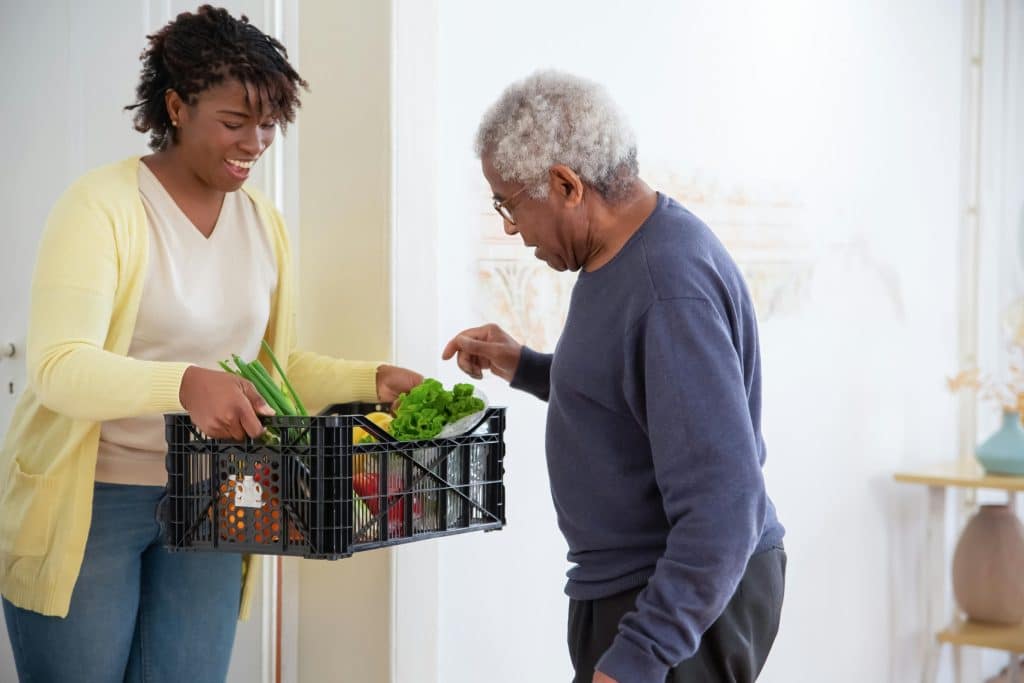
Food Not Bombs, for example, offers meals at different spots around the city and is funded by the proceeds from certain punk shows. Other examples are community fridges, some urban gardens or farms that offer free food to their neighbors, or direct distribution models where people will bring food directly to neighbors in need.
Another example is Auntie Na’s Village in the Dexter-Linwood neighborhood. Sonia Brown, known as “Auntie Na” to the community that relies on her, has repurposed a disinvested block in the neighborhood. Vacant lots have become gardens, and empty houses have been transformed into places that meet community needs.
The Nutrition House has a food pantry as well as infant formula and diapers for young parents in need. The Medical House offers screenings and basic care, provided by Wayne State medical students. And the Homework House offers space and internet access for youth in the neighborhood to complete schoolwork and enhance their learning.
It all started because Brown was one of those neighborhood moms and grandmas who were always looking out for the kids in the neighborhood, making sure they didn’t get into dangerous situations and picking them up, and taking them to do fun things during school and summer breaks. “My food program started because these kids were hungry,” she says. “I was always making sandwiches and Kool-Aid for them, so I started going around the city picking up from people who had food to give.” The community gardens stemmed from that, and eventually, the Nutrition House opened so a broader group of people could get food.
What drives her is a firm sense of justice in a world where some people have more than they could ever need and some struggle just for basic necessities. She’s seen the effects of treating people and places as disposable or not worthy of investment, and she says she absolutely refuses to let that happen in her community. It’s been a great deal of work and taken a lot of her resources. “I’ve sold everything but my soul and my sofa,” she says. But she has no intentions of walking away from the community she’s created.
During the pandemic, through the Food Secure Detroit initiative that Detroit Food Policy Council led, Brown connected with Food Rescue US, led by Darraugh Collins. Food Rescue US runs a network of volunteer food rescuers, who pick up food from businesses, nonprofits, and more, and distribute it to community agencies in need.
Collins came to this work in an unusual, and some might say serendipitous, way. Shortly before the pandemic, she and her husband were planning a move to Detroit for his job. On a flight to Detroit ahead of the move, she happened to pick up a magazine that featured an article about the Food Rescue US national organization. Intrigued, she contacted them and discovered they did not have a site in Detroit. She was meeting leaders in the hospitality industry through her husband’s work, and those contacts were telling her they had food going to waste because there wasn’t someone to pick it up.
Large food rescues like Forgotten Harvest couldn’t devote the resources to pick up a couple of big pans of leftover chicken from an event or a few dozen unsold loaves of bakery bread. With its volunteer-based structure, Food Rescue US can pick up the leftovers. They also have a network of social service agencies that are able to put surplus food to immediate reuse.
Despite being a new Detroiter at that time, Collins responded in true Detroit fashion and decided she’d become a site director for Food Rescue US and bring their model to Southeast Michigan. She manages a team of more than 800 dedicated volunteers who are ready to rescue food on fairly short notice and deliver it to an agency that has expressed a need.
Connecting community volunteers with an agency that helps community people in need is a big part of what makes Food Rescue US special, Collins says. ”We involve them in this process where they see the issue, and they see how their role in it is affecting the community in a positive way. That gets more people working towards solutions.”
Two newer initiatives that Food Rescue US Detroit is working on are their power outage program and setting up two community fridges. Typically, when a grocery or big box store loses power, all the refrigerated or frozen food they have goes directly into the dumpster. Food Rescue US is creating a functionality on their app where they can be alerted when a store loses power and collect food that would otherwise be thrown out, particularly important because people in need are also losing food if they also experience a power outage, and it can be prohibitively expensive to replace it.
They are also purchasing and locating two community fridges in Detroit, after an in-depth process of working with partners who saw the need for community fridges and could keep them clean and stocked. Community fridges are just what they sound like – a publicly accessible refrigerator, and sometimes freezer, that people can contribute to and also take what they need from, with no stigma or paperwork that can stop people in need from accessing help.
“I think that we have an image of who we think needs food and that image is inaccurate, because there are so many people that need food that might be someone sitting next to us, that we work with, or sit next to at doctor’s office, and we don’t think about it because we have a visual of who we think that person is. And that’s a very limiting view of food insecurity, “ Collins says.
Related Articles
Detroit has community buy-in for Solar Neighborhoods Initiative
With 139 square miles of land – some blighted or unused and ripe for repurposing – Detroit is well-positioned to develop solar farms to help power city buildings.
Forestry funding helps bring Woodbridge affordable housing, horse barn, and ‘filter forest’ to life
Three Detroit grantees have ambitious plans for grant funds plans awarded for efforts to expand tree canopy and strengthen local green infrastructure.
Detroit youth feel the impacts of climate change, and they’re talking about it
Detroit is one of the most impacted cities by rising temperatures. Youth are speaking up about the impacts they face when it comes to climate change, and Green Living Science is helping kids pave the way to a more sustainable future.