Young and Asian in Detroit
The Detroit Asian Youth Project is a cultural immersion programdesigned to bring young Asians out of their adopted neighborhood andopen them up to their city.
For several Detroit high school students a recent tour of the city was
a real eye opener, though what they experienced doesn’t immediately
standout as remarkable. They visited a senior citizen housing project,
a park where they show movies, a fountain by the river and a
playground. But to children of Hmong refugees from the Vietnam War,
many of whom have been sequestered in a small ethnic enclave on the
northeast side their entire lives, seeing parts of the city for the
first time revealed to them a bigger picture of community in Detroit.
The
tour of Detroit was part of the Detroit Asian Youth (DAY) Project’s summer program, an
annual, month-long cultural immersion program designed to bring young
Asians out of their adopted neighborhood. Most of the Hmong — an
ethnic-Asian minority that originated in southern China then migrated
into Laos, Myanmar, Thailand and Vietnam — live east of City Airport on
residential streets near Conner, Gratiot and McNichols avenues.
There
are about 4,000 Hmong and other Asian immigrant families living in
Detroit. They generally come from the lower income strata and lack many
of the amenities that suburban Asian kids enjoy. Their social life
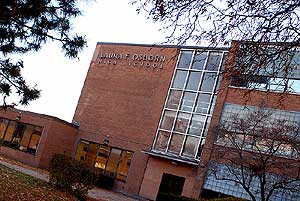
consists of school activities at Osborn High School and family
functions. Now in its fourth year, the DAY Project takes high school
students out of their neighborhood and into Detroit’s wider-ranging
cultural life.
Intangible identity 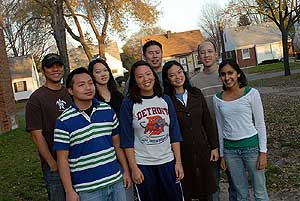 Many young Asians in
Detroit have difficulty identifying as Asian-Americans, much less
Detroiters, says Michelle Lin, coordinator of the DAY Project. “They
think of themselves as Hmong. They think of themselves as Asian,” Lin
says. “‘Asian-American’ is something more intangible that they can’t
really grasp.”
Lin says that many Asian immigrants don’t
view themselves as being part of a pan-ethnic community. “Koreans
thought that they were Korean, different from Chinese, different from
Vietnamese,” she says. “We have no commonality; in Asia those are
different countries, different nationalities. You don’t have a shared
experience over here,” says Lin, a native of Taiwan who is a community
development specialist at the Cass Corridor Neighborhood Development
Corp.
The Hmong in Detroit are largely unaware of this
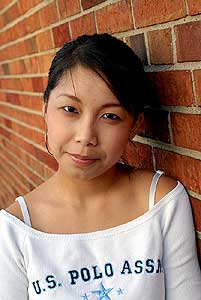
experience. Yet the young, like Dia Shia Yang, find it in the DAY
Project. She spoke about the importance of understanding history at the
DAY Project’s summation program held in August. In her poem, “The Voice
of Detroit,” she writes, “Detroit has a history/A history that made
history.” It’s a history inclusive of young and old, black and white,
and the “baddest to the best.” The voice of her poem speaks to the
trauma of this history in which “People built cars and roads on
me/making my back ache. More people moved in/stepping on my face.” She
plaintively asks the questions: “Why do you hate each other? Can’t you
just get along?”
Yang believes that while she looks at Detroit
history from a distance and sees it as traumatic, she also sees herself
as part of a history that’s unfolding. “I think I fit in. I was born in
Detroit.” While feeling alienated from black, white, and other Asians
in the suburbs, Yang says she has several black friends and considers
Detroit her home.
Raising awareness and inspiration
 The
The
goal of the DAY Project is to develop leadership skills and raise
awareness of social justice issues by understanding Detroit and its
Asian-American community. It was established in 2004 as a result of the
conference, “Bridges to the Future: Asian Americans and Community
Organizing.” Support for the DAY Project was provided by the Boggs
Center to Nurture Community Leadership, Asian American Center for
Justice, Detroit Summer, and the Detroit Chinatown Revitalization
Workgroup.
The DAY project was inspirational for Mai Ka Yeng
Moua. Born in Thailand, Moua has lived on the eastside for 11 years and
graduated from Osborn this spring. When there was no school, there was
nothing to do, she says. On the other hand, during the DAY Project’s
field trip, she felt like a tourist in her own city. “I’ve never really
gone down there (downtown),” Moua says. “My parents work. My mom
doesn’t really know this area. We don’t normally go down there, unless
it’s for business.”
Like Yang, Moua is troubled by the way
people look upon Asians living in Detroit. In one of the DAY Project’s
field trips to the University of Michigan, students there were
surprised to find out that Moua lived in Detroit. “They started asking
questions like, ‘How do you get around on the street?’” Moua responded
matter-of-factly: “I just walk. I walk with somebody, I don’t just walk
alone.” And, like Yang, she has black friends and likes her
neighborhood.
A shy person, Moua found that the interpersonal
aspect of the project helped bring her out of her shell. “I’m not used
to being around a lot of people,” she says, “just my family.” Mentors
working in the DAY project — older Asian young people, including Lin —
were individually supportive, Moua says. “They made me feel really
comfortable. I didn’t know a lot about Detroit. Even though we go to
Detroit Public Schools, they don’t talk about the history of Detroit,
or how it came to be. Sometimes you wonder: ‘Why is it like this?’ You
never really know where to look for an answer. … It seems like you live
here, but everything is new to you.”
Becoming a community person
 Despite
the hardships of her life in Detroit, Moua believes she’s better off
for the experience. “I wasn’t given everything handed down to me. I had
to make my way through it. It gave me a sense of who I am. It made me
appreciate my life … and my community more.” Like Yang, she says she’s
a Detroiter, “but not like a downtown person. I’m more like a community
person. I (just) wish that they would build gardens and playgrounds for
kids.”
Moua talked this summer of her plans to study optometry at Ferris State, although she also has an interest in social work.
Will young people like Moua and Yang leave Detroit forever once they go
to college? Both feel a sense of place in Detroit and plan to return
after school. “If a lot of people move away from it, the city is just
going to go down,” Moua says. “I want to come back. For me, there
wasn’t a lot of help around. I know how that feels. I don’t want to
leave youth behind. I want anyone who lives in the community to have a
future too.”
Lin sees sufficient potential for young
people to develop their lives in Detroit. “It’s in the city,” she says.
“It’s up to us to find potential within us. Maybe we need support
outside the city to jumpstart that. I think all of the resources, the
knowledge, and the passion is within the city right here. Maybe people
don’t see it (because) it’s not on the news. But it’s already
happening.”
To learn more about the DAY Project, which has an after-school program running this fall, click here. You can also watch their “commercial” on YouTube and contact them at falldayindetroit@umich.edu.
Photos:
DAY Project Participants
Osborne High School
DAY Project Vlounteers
Dia Shia Yang
All Photographs Copyright Dave Krieger
Related Articles

Michigan Adventurer to Bike 1,000 Miles Across State to Spotlight Hidden Form of Domestic Abuse
A Michigan adventurer is biking over 1,000 miles across both peninsulas this summer to raise awareness about economic abuse: a hidden form of domestic violence that affects countless survivors across Michigan.
Detroit schools are making real gains in reading and math: 4 strategies that are working
The city’s schools are making progress faster than peer districts, but that progress could be fragile.

From brunch to wellness, here are some ways to celebrate Mother’s Day in Detroit
From brunch and dinner specials to wellness and healing-centered experiences, several Detroit businesses are offering plenty of ways to celebrate Mother’s Day.