In search of alternatives to urban sprawl
Metro Detroiters have been living with urban sprawl for more than a generation. Patrick Dunn dives into one of our region's most controversial topics in this first installment of our series on solutions to regional issues.

Corridors lined for miles with strip malls. Big box stores surrounded by surface parking lots. Winding subdivisions of single family homes.
This is the face of urban sprawl, a term that denotes untidy, sparse development. Metro Detroiters have lived with it for over a generation. But demand is changing, and many planners are working towards a new vision of regional life by investing in downtowns and curbing development elsewhere.
“At this point, so many resources have been invested into configuring lifestyles for how people live, work and play around the automobile and highway infrastructure,” says Detroit planning director Maurice Cox. “We’ve come to not even question it. Entire generations have grown up in it and know no other urban paradigm.”
Do you think the term “urban sprawl” applies to your community? Tell us in the anonymous survey at right. We’ll post your answers >>>
Despite these trends, Cox suspects that “the tide has turned” on sprawl. He notes that suburban housing is currently overbuilt, while two groups at opposite ends of the age scale—millennials and baby boomers—are increasingly losing interest in the suburban lifestyle.
Investing in downtowns
As far as national models go, Beyea says the oft-cited Portland Urban Growth Boundary (UGB) is the “poster child” for sprawl mitigation. The UGB is a literal line in the sand separating rural, low-density areas from urban, high-density ones. State legislation signed in 1973 required every Oregon city to establish a UGB, but Portland’s has been particularly notable for the way it’s densified and transformed the state’s largest city.
“They’ve been able to have the critical mass necessary for light rail and vibrant entrepreneurship, in terms of new businesses and location of housing,” Beyea says. “This urban service area seems to be a concept that has played out well in both larger and smaller communities as a way to curb sprawl.”
It may be too late (and likely politically untenable) to draw a line limiting urban development in Metro Detroit. But building up a dense urban core is still very much a viable solution, and one that’s already shown success. Downtown Detroit, of course, has seen considerable revitalization in recent years, with businesses and mostly higher-density housing proliferating.
Cox says that’s been driven largely by businesses like Compuware and Quicken Loans making the move downtown. But for the city’s next step, he’s envisioning a much broader transformation driven by municipal policy. He notes that the city has numerous neighborhoods, from Mexicantown to the Livernois-McNichols area, that have had walkable Main Street-style communities in the past and could again.
“We have all of the infrastructures to create a different option, as well as the authenticity of the history of these neighborhoods and institutions that remain,” he says.
Cox says those neighborhoods could become an attractive “antithesis” to the suburbs, guided by a placemaking plan that breaks down to three basic steps: removing blighted structures, rehabilitating existing housing stock and “greening everything else.” He envisions what he describes as “20-minute neighborhoods” for Detroit, where all basic amenities are within a 20-minute walking distance.
“In the end, it was land use and zoning that created the suburbs,” he says. “It’s going to be land use and zoning that reshape this kind of urban, walkable place that Detroit’s neighborhoods can be again.”
A focus on developing walkable Main Street communities has also been a part of the playbook in some suburban communities. The Main Street Oakland County program has contributed to the revitalization of the county’s traditional downtowns. The program claims to have attracted more than $700 million in public and private reinvestment over the past 15 years in 21 downtown communities.
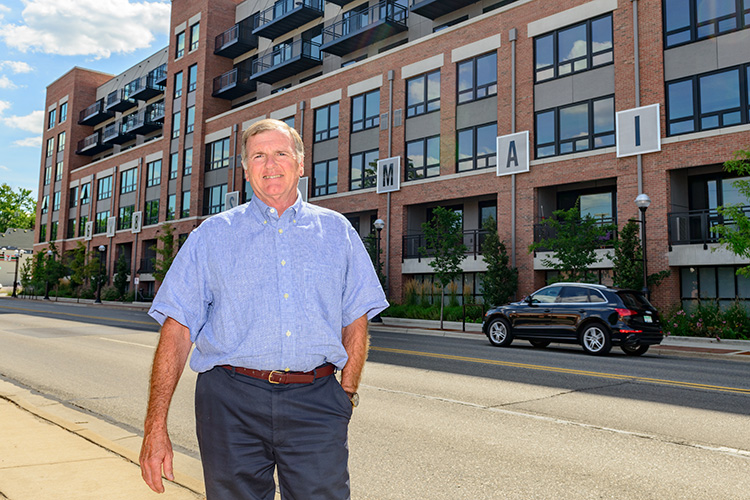
Birmingham planning director Jana Ecker notes that Birmingham’s form-based code has helped to preserve and revitalize the city’s historic downtown, but it’s also helped to transform areas that didn’t necessarily have such a pre-existing appeal. The 2007 adoption of a form-based code in the city’s Triangle District has replaced urban sprawl-style surface parking lots and strip malls with more attractive mixed-use developments. Ecker says a form-based code is “absolutely” viable for any community.
“I think a form-based code approach forces you to look more at the individual approach on the street and to look at how and where the buildings are placed and how it affects the type of environment,” Ecker says. “Places with a form-based code are much more likely to be successful, vibrant places where people want to be and want to get out of their car and walk, rather than just drive through.”
Other experiments in fighting sprawl
The program preserves existing farmland and other green spaces as conservation easements, allowing current landowners to maintain the properties as they usually do while prohibiting further development on the parcels in perpetuity. Thornton says the city is working hard to build up blocks of greenbelt parcels measuring 1,000 acres or more, creating green corridors around sprawling areas.
“We are getting there, but there’s obviously a lot more work to do because there’s still some development pressure,” she says.
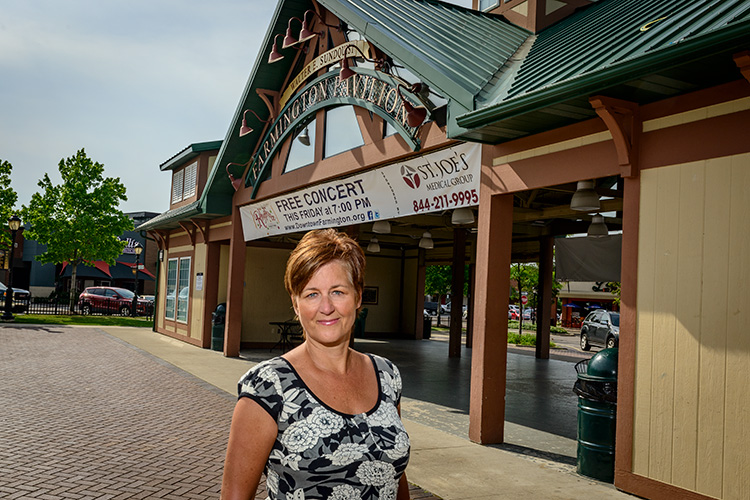
Another possibility lies in “retrofitting” existing sprawling developments. Consider Farmington’s Sundquist Pavilion, a 0.75-acre park and community event space that was once a strip mall parking lot. Since its opening in 2005, the pavilion has become a community gathering place that hosts public concerts and festivals, a weekly farmers market, and private events.
Farmington Downtown Development Authority executive director Annette Knowles says projects as large-scale as the pavilion can be costly, but the city is considering redeveloping other sites to make more “pocket-sized” event centers in the future.
“You have to balance out infrastructure with opportunities to just relax and unplug from buildings and parking lots and things like that,” Knowles says. “You can’t just have building stock and nothing else by it.”
Carlisle says he expects market demand from millennials and baby boomers will drive a shift away from sprawl, with little interference needed at the policy level. But from a public infrastructure standpoint, he says the region needs to establish a comprehensive transit system to serve denser urban neighborhoods and their car-independent residents.
“At some point in time we have to begin to understand that there’s going to be a whole generation of people that either don’t want to or will not be able to own a car,” he says. “Frankly, that’s going to cross generations.”
UPDATED 8/3/16 A scuttling of a rare opportunity to advance a transit solution may have been narrowly averted this week. County executives in Macomb and Oakland counties had put forth objections to the funding and governance structure of the Regional Transit Authority of Southeast Michigan‘s proposed master plan. The plan had been in development since 2012 and was set to go before voters in Wayne, Oakland, Macomb and Washtenaw counties this November, pending approval by the RTA board. A vote last week failed, with representatives from Oakland and Macomb voting “No.” A last-minute compromise may yet send the measure to the ballot, pending a vote by the RTA Thursday.
In the meantime, a project to widen I-75 in Oakland County is expected to begin this summer.
Beyea says metro-area communities will need to work together to turn the page on urban sprawl. He says some of the groundwork for that mentality is already taking root, as some municipalities have started creating resource-sharing agreements out of financial necessity after the recession.
This piece is part of a solutions journalism series on Metro Detroit’s regional issues, conducted in partnership with Metro Matters and guided by our Emerging Leaders Board.
This work is funded by the Community Foundation for Southeast Michigan. You can view other pieces in this series here.
Related Articles
Returning citizens face extra hurdles in Detroit’s already challenging housing market
Formerly incarcerated people face numerous challenges in finding housing, often leading them to become homeless or recidivate.
CDFIs investments in childcare allows daycares like Detroit’s Lil Love Bugs to further invest in children’s futures
Childcare is not a family issue, but a workforce issue. Members of the MI CDFI Coalition showcase how investing in quality, affordable childcare and early childhood education positively impacts the entire community.

Partner Partner Content Don’t Let Fraud and Scams Ground Your Summer Vacation
Planning a summer getaway? Before you book, learn how to spot common travel scams and protect your money so your vacation stays stress-free.